

Wooden Bunk Beds Full Over Full: A Complete Guide

Your guests have arrived, the luggage is open, and an adult is looking at the upper bunk as though it belongs in a child's bedroom. You need a more useful sleeping arrangement, but you don't want to fill the room with furniture that feels oversized, awkward, or difficult to maintain.
Wooden bunk beds full over full can make sense for a vacation rental, family cabin, or beach condo. The right purchase starts underneath the mattress, not with the stain color. Ask how the foundation carries the intended occupants, how the guardrails work with the finished mattress, and how someone will inspect the connections after guests leave.
Why Full Over Full Beds Are a Bigger Decision Than They Look
An adult climbs the ladder, sits on the upper mattress, and notices movement at the rail. That's a hypothetical situation worth considering before ordering, because a wider mattress alone won't make a bunk suitable for adult guests.
A full-over-full arrangement provides larger sleeping surfaces above and below. It doesn't automatically provide better headroom, greater load capacity, or permission for additional occupants. Those are separate decisions that need separate answers.
For a family reunion home, the attraction is straightforward: make an existing bedroom more useful without adding another bedroom. For bunk beds for Airbnb properties, the challenge is making that arrangement understandable to unfamiliar guests and manageable for the people maintaining it.
Think Beyond the Mattress Footprint
The larger mattresses can increase overall weight, mattress thickness, and loads transferred through the foundation, rails, ladder, and end frames. That's why ASTM F1427 addresses bunk beds as complete systems, including structural integrity, falls, entrapment, labeling, and instructions.
My recommendation is to evaluate the bed in the order someone will use it:
Approach: Can a guest reach the ladder without moving luggage or furniture?
Climb: Is the access arrangement appropriate for the intended users?
Sleep: Does the documented foundation support the selected mattress and permitted occupants?
Maintain: Can the property manager reach the connections and inspect the supporting parts?
Buying rule: A larger mattress is a space-planning choice. Adult suitability is a documentation and construction question.
Custom bunk beds earn their place. A stock configuration asks the room and occupants to fit an existing design. A custom project lets you specify the room constraints, access position, mattress configuration, and appearance before the builder finalizes the bed.
Customization isn't proof of quality by itself. The useful difference is the opportunity to resolve those decisions deliberately, rather than discover the compromises after delivery. Treat material, hardware, finish, and inspection access as purchase criteria, not optional upgrades.
Choosing the Right Wood for a Full Over Full Frame
Buy the construction specification before you buy the wood species. Oak, maple, ash, pine, cedar, and engineered panels are material choices, not complete descriptions of a bunk bed's performance.
For heavy-duty bunk beds, I'd ask the builder to identify what material goes into the posts, side rails, mattress supports, guardrails, and decorative panels. A quotation that says only “solid wood” leaves too much unanswered.
Match the Material to Its Job
I'd shortlist oak, maple, and ash for an adult-focused rental proposal, then compare the actual rail sections and connections. I wouldn't approve a frame because the hardwood name sounds substantial. Ask how the builder selected the material for the intended use.
Pine deserves consideration for rustic bunk beds and family guest rooms, provided the construction and documented occupancy suit the project. I'd evaluate cedar separately rather than assume a coastal association makes it the right structural choice.
Furniture-grade plywood and hardwood laminates also need precise descriptions. Ask which components use them, how exposed edges will be finished, and whether a panel is decorative or part of the load-bearing system.
Wood Species Compared for Full Over Full Bunk Beds
Species | Density and Load Behavior | Coastal Durability | Finish Compatibility | Best Fit |
|---|---|---|---|---|
Oak | Request the grade, rail dimensions, and connection details | Specify protection for the actual indoor exposure | Approve a sample showing the intended grain appearance | A hardwood option to evaluate for rental frames |
Maple | Assess the finished support system, not density alone | Require a complete finish specification | Review the selected paint or stain on a sample | Clean-lined custom bunk beds |
Ash | Confirm its role in posts, rails, and supports | Ask how exposed surfaces and joints will be protected | Compare samples before approving color | Visible-grain furniture-style designs |
Pine | Require documented suitability for intended occupants | Include wear inspection and touch-up provisions | Approve the complete preparation and coating sequence | Rustic and occasional-use room proposals |
Cedar | Don't infer structural suitability from the species name | Don't substitute material choice for exposure planning | Verify the proposed coating with its manufacturer | Selected components where the builder specifies it |
Furniture-grade plywood and hardwood laminates | Distinguish structural components from decorative panels | Detail exposed edges and concealed surfaces | Confirm compatibility with the exact panel product | Built-in-look surrounds and millwork |
When the budget is fixed, protect the foundation, connections, and appropriate materials first. Simplify decorative end panels before compromising those items.
Ask for a finished sample, not just a stain name. Review it beside the flooring and wall color, and ask how the approved surface will be repaired after ordinary rental wear.
What Adult Rated Really Means for Full Over Full Designs
“Adult rated” should lead to paperwork, not end the conversation. A full-size upper mattress doesn't establish how many people may use it, and a general capacity statement doesn't explain the tested configuration.
For adult bunk beds, the manufacturer or importer must issue a General Certificate of Conformity based on testing or a reasonable testing program. The CPSC's bunk-bed compliance guidance explains that obligation. Ask for the applicable documentation before approving a rental installation.
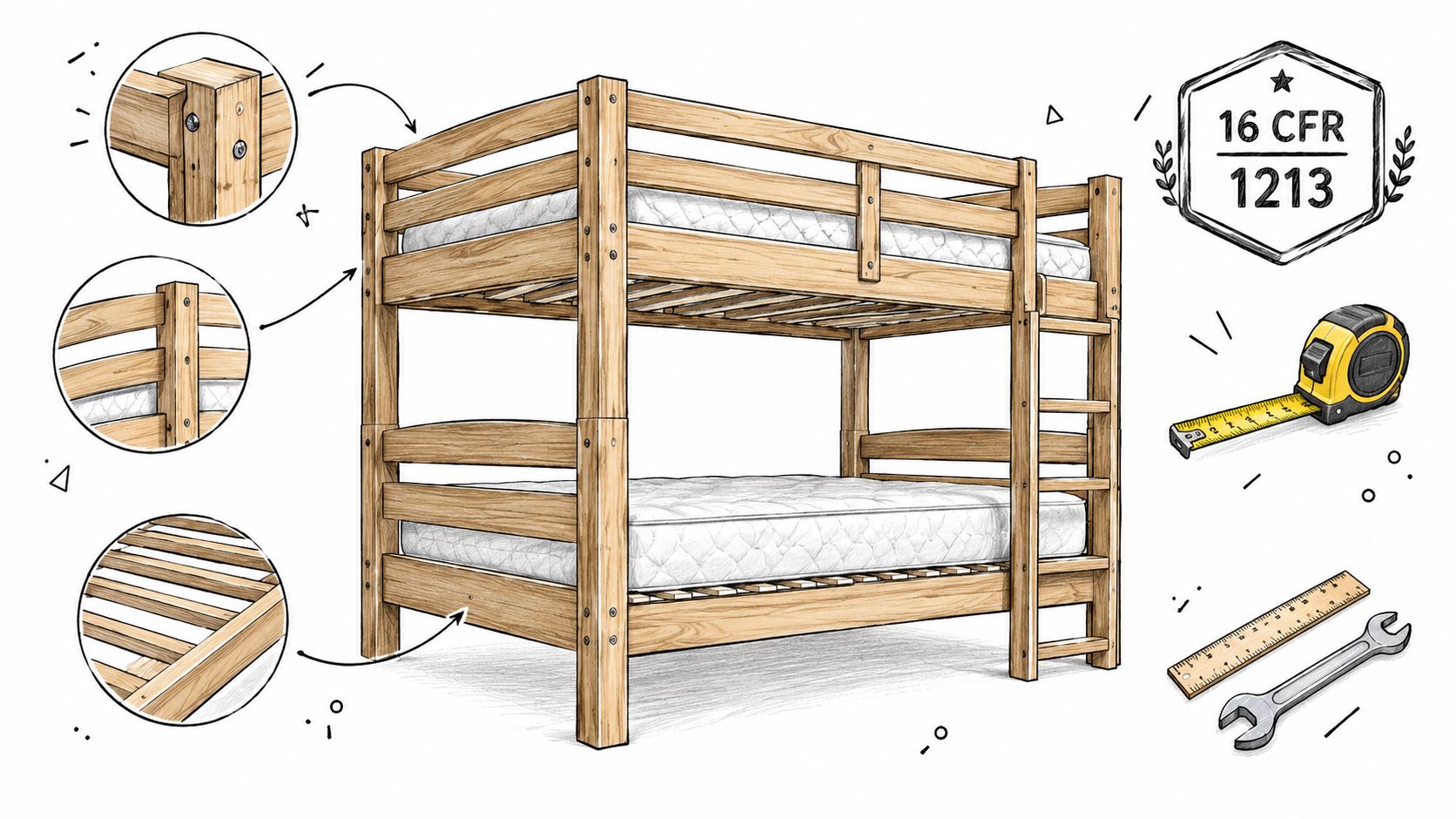
Measure the Finished Sleeping System
Under 16 CFR Part 1213, adult bunk beds require upper guardrails on both sides. The wall-side rail, or rail opposite the ladder, must be continuous; an unattached end gap cannot exceed 0.22 inches, permitted non-wall-side end gaps cannot exceed 15 inches, and rail tops must extend at least 5 inches above the mattress, as detailed in the CPSC's guardrail requirements.
These are not dimensions to approve from an attractive rendering. Verify the installed mattress against the manufacturer's permitted size and thickness, then check the completed assembly.
Request Written Answers Before Purchase
Use a comparison resource such as Park City Bunk Beds' adult bunk bed buying guide to organize your questions, but evaluate the documentation for the actual proposed bed.
Occupancy per level: Request the permitted number of occupants, not merely a combined frame capacity.
Foundation configuration: Identify the specified slats, supporting rails, attachments, and any required additional supports.
Mattress compatibility: Record the permitted size, thickness, and foundation arrangement.
Connections: Ask how guardrails, rails, and access components attach, and how those attachments are inspected.
Records: Retain the certificate, assembly instructions, identification information, and warnings.
Don't advertise shared upper-bunk sleeping unless the manufacturer expressly permits it. Larger sleeping surfaces don't override occupancy instructions.
A strong-looking frame isn't a substitute for a documented sleeping system.
For vacation rental bunk beds, this distinction matters more than the phrase "heavy duty." Your guests won't know what was discussed during the sale. They'll need clear instructions that match the bed installed.
Freestanding, Built In Look, and Hybrid Installations
Choose the installation approach from the room conditions, not the listing photograph you want to recreate. Freestanding, built-in-look, and hybrid systems can each be appropriate, but they create different obligations for access, cleaning, and future changes.
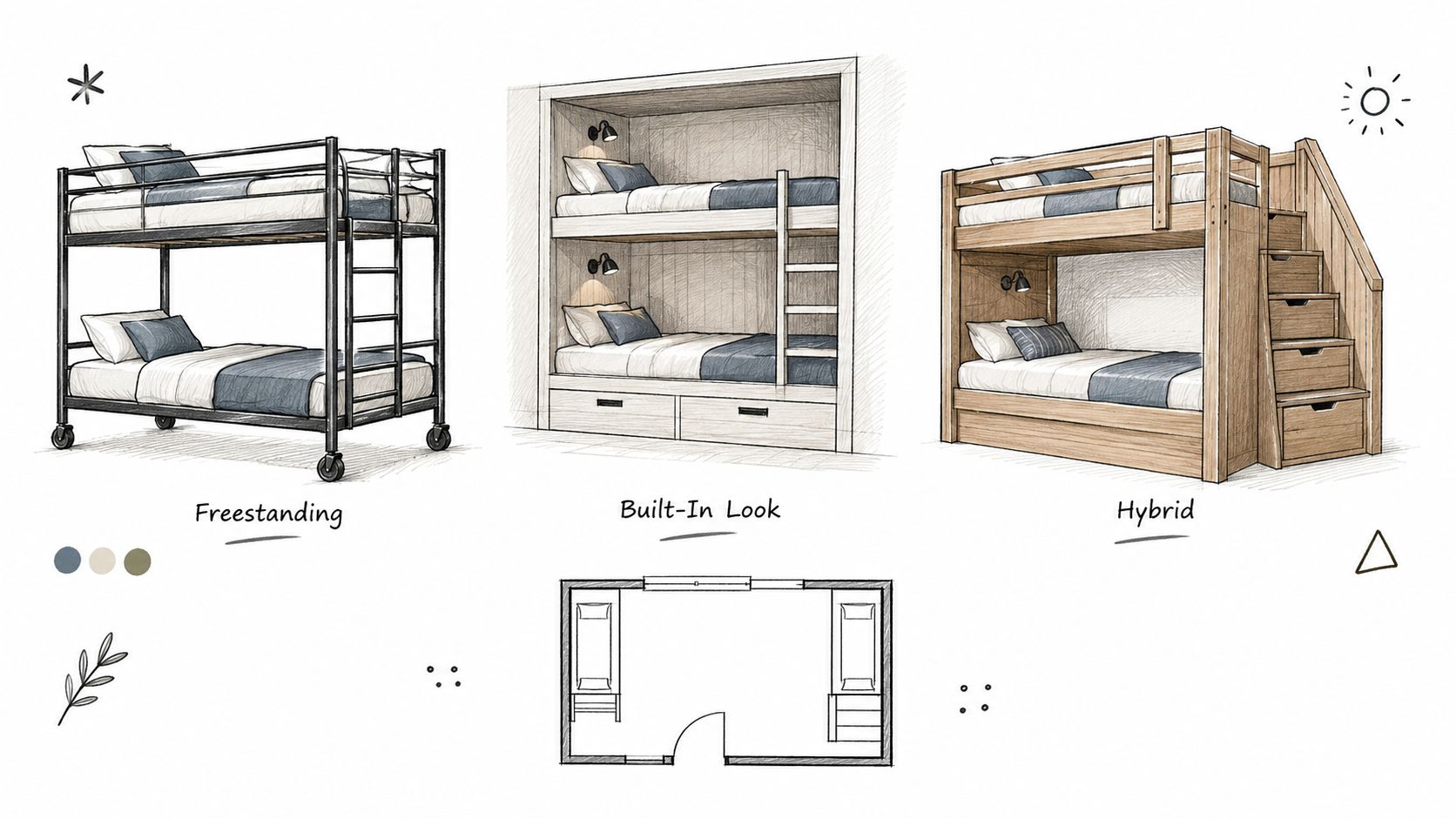
Freestanding for a Room That May Change
I'd favor a freestanding proposal when the owner expects to rearrange the bedroom or wants to preserve access around the frame. Ask how the assembly can be moved or disassembled, rather than assuming “freestanding” means effortless relocation.
This approach suits a family cabin that alternates between guest use and reunion use. It also deserves consideration when a rental owner hasn't settled the room's long-term layout.
Built-In Look for an Integrated Room
Built-in-look bunk beds can coordinate with shiplap, wall paneling, storage, and surrounding trim. For modern rustic bunk beds in a mountain home, that may mean restrained detailing rather than a room full of competing wood textures.
The important distinction is appearance versus attachment. Ask what is structurally connected to the building, what is decorative, and what must remain removable for inspection. Don't let trim conceal a connection that someone needs to service.
Hybrid for a Defined Compromise
A hybrid proposal can combine a furniture-style core with surrounding end panels, stairs, or architectural trim. I'd consider it when the owner wants an integrated appearance but also wants a clearly defined path for accessing the bed's working parts.
Compare proposals against practical conditions:
Changing layout: Prioritize a documented disassembly and reassembly plan.
Angled ceilings: Request a room-specific elevation showing the complete mattress position.
Cleaning access: Show how staff will reach beneath and behind the assembly.
Attachment decisions: Have the builder specify appropriate anchoring rather than improvising it after delivery.
No installation style excuses hazardous gaps. The federal safety framework addresses entrapment involving walls and bed openings, a concern documented in the historical ASTM bunk-bed safety record.
A polished installation should remain inspectable. If the only way to reach important hardware is to remove finished millwork, resolve that before signing off.
Coastal Durability and Finish Choices for Salt and Humidity
For bunk beds for beach houses, I'd reject a finish specification that amounts to “coastal white” or “marine-grade coating.” Those descriptions don't tell the owner how the wood was prepared, which surfaces were coated, or how the hardware was selected.
Specify a finish-and-hardware system. Ask the builder and coating manufacturer to address the actual indoor environment, including humidity control, cleaning practices, and exposure to beach air. Don't assume a product intended for another application belongs on sleeping furniture.
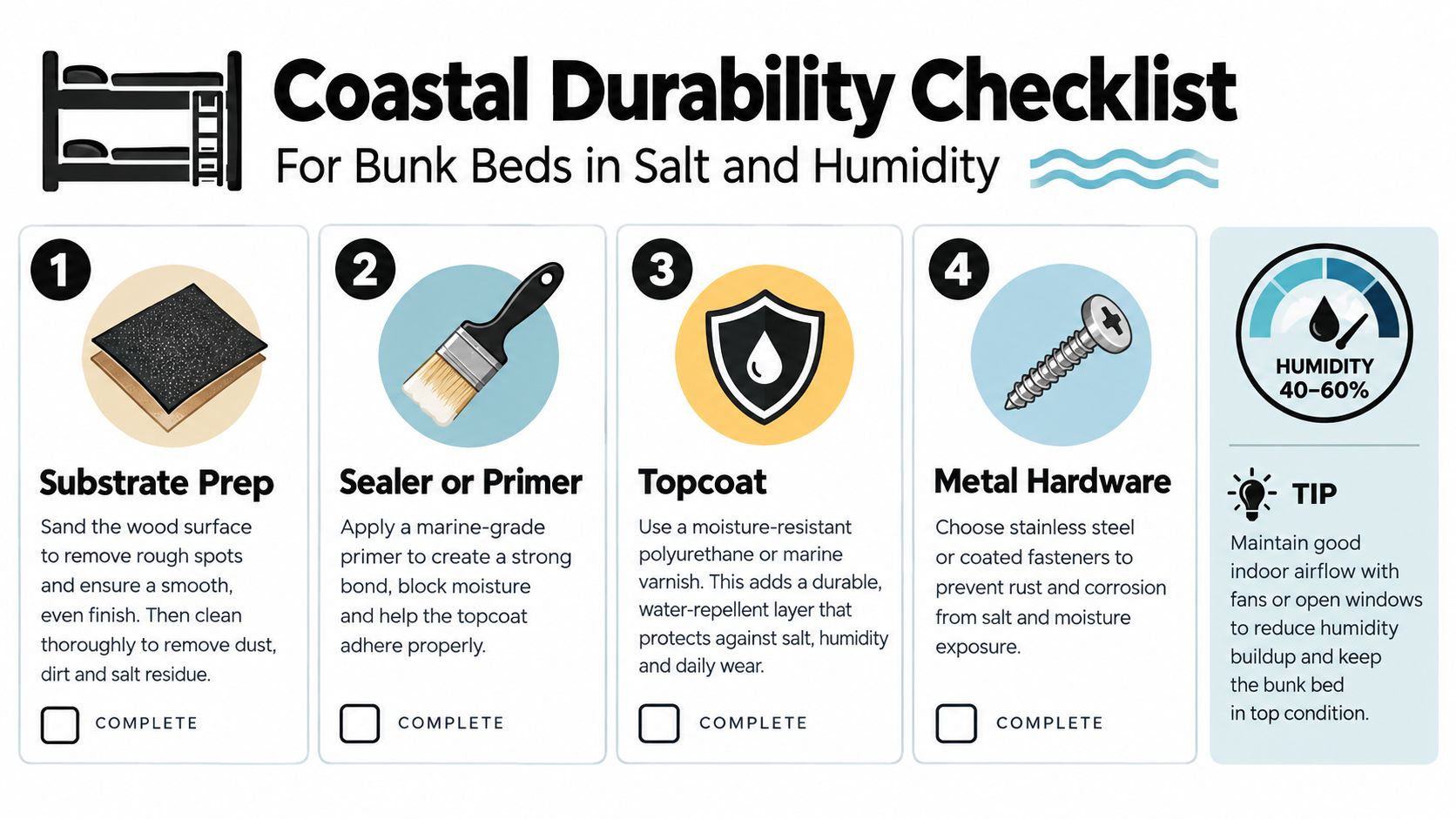
Ask for the Entire Coating Sequence
Start with substrate preparation. Request the sanding, cleaning, and surface-preparation requirements for the selected wood and coating. Then ask which primer or sealer belongs beneath the topcoat and which concealed surfaces receive protection.
I wouldn't claim that every interior polyurethane fails quickly near the coast. I also wouldn't accept a promise that marine varnish makes maintenance unnecessary. Without product-specific information and actual exposure conditions, neither statement is a useful buying standard.
Compare coating proposals by the questions they answer:
Marine-oriented coatings: Is the exact product appropriate for interior furniture, and what preparation and curing instructions apply?
Factory-applied catalyzed finishes: What repair procedure and compatible touch-up materials will the owner receive?
Oil-based rub-in finishes: What cleaning and renewal routine does the manufacturer prescribe?
Painted systems: Which primer and topcoat are approved together on the selected substrate?
Don't Leave Hardware Out of the Specification
Ask for fastener and connector materials by component, including concealed brackets. Where stainless steel or protective coatings are proposed, request confirmation that the hardware suits both the exposure and its structural role.
The failure points I'd ask the maintenance team to watch include damaged coating near joints, exposed end grain, staining around hardware, and damp enclosed areas. Treat those as inspection targets, not a reason to apply another coating over an unidentified problem.
Coastal specification: Name the preparation, primer or sealer, topcoat, hardware, and repair method before approving the color.
For built-in-style surrounds, ask how the design avoids inaccessible damp pockets and allows appropriate airflow. Discuss that with the builder before closing the assembly with decorative panels.
On color, my preference is a finish the owner can maintain consistently. Approve a physical sample under the room lighting, then establish how touch-ups will match it. A fashionable paint name is less useful than a repeatable repair method.
Maintenance That Extends the Life of a Rental Bunk Bed
A rental bunk needs a maintenance routine that survives a busy checkout day. Give the property manager a written checklist, access to the assembly instructions, and a clear rule for taking the bed out of service.
The schedule below is a proposed operating routine, not a replacement for manufacturer instructions. Use the specified tightening procedure and torque where provided. “Check the hardware” doesn't mean tighten every fastener harder.
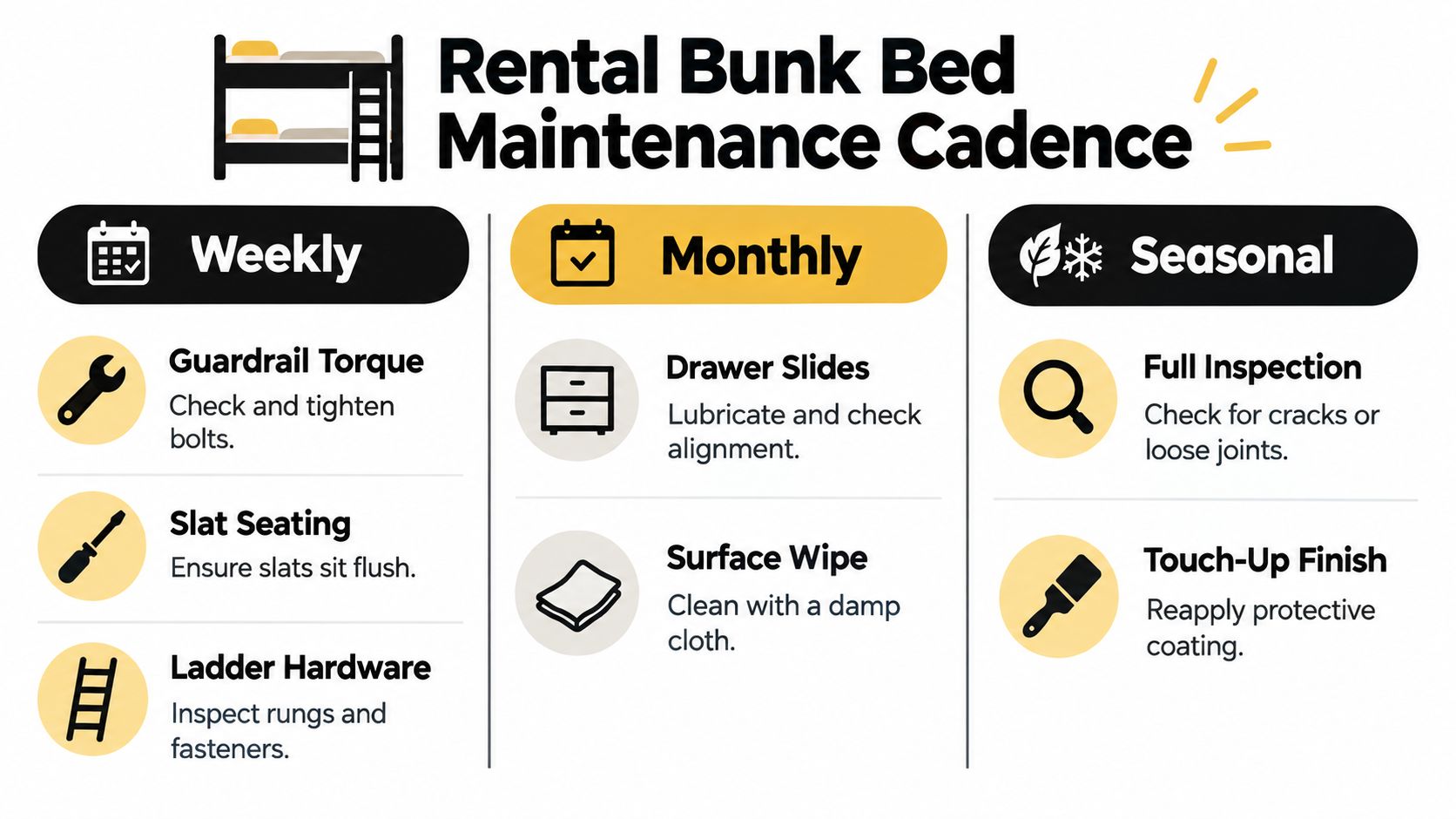
At Turnover and During Routine Checks
Have staff report movement, damage, missing parts, or a changed mattress before the next guest uses the room. They shouldn't diagnose a structural problem while racing to finish housekeeping.
At each turnover: Check accessible guardrails, ladder attachments, visible supports, and the access path.
During monthly maintenance: Inspect slat seating, supporting rails, stair treads, and any drawer or trundle mechanisms.
At seasonal reopening: Review the complete assembly, finish condition, concealed inspection points, and records.
After moving or repair: Require verification against the correct assembly instructions before returning the bed to use.
The same discipline applies when comparing adult bunk bed configurations. Choose a design the maintenance team can inspect, not merely one the owner likes in photographs.
Match Cleaning and Repairs to the Finish
Request the approved cleaner by product name from the finish supplier. Don't let staff substitute abrasive pads, solvents, oils, or disinfectants without confirming compatibility.
For moving storage components, use lubricant only where the mechanism manufacturer specifies it. For worn rails or exposed end grain, follow the documented preparation and repair procedure rather than layering an unrelated finish over the damage.
Keep an owner file containing the installation date, mattress identification, instructions, hardware specifications, inspection notes, and completed repairs. Record actual tightening values only when applicable and specified.
That log isn't a liability shield or a warranty promise. It gives the next manager usable information and helps distinguish an isolated adjustment from a recurring problem. If a structural component is damaged or won't remain secure, stop use and obtain the manufacturer's repair direction.
Planning a Bunk Room Around Layout, Ceiling Height, and Safety
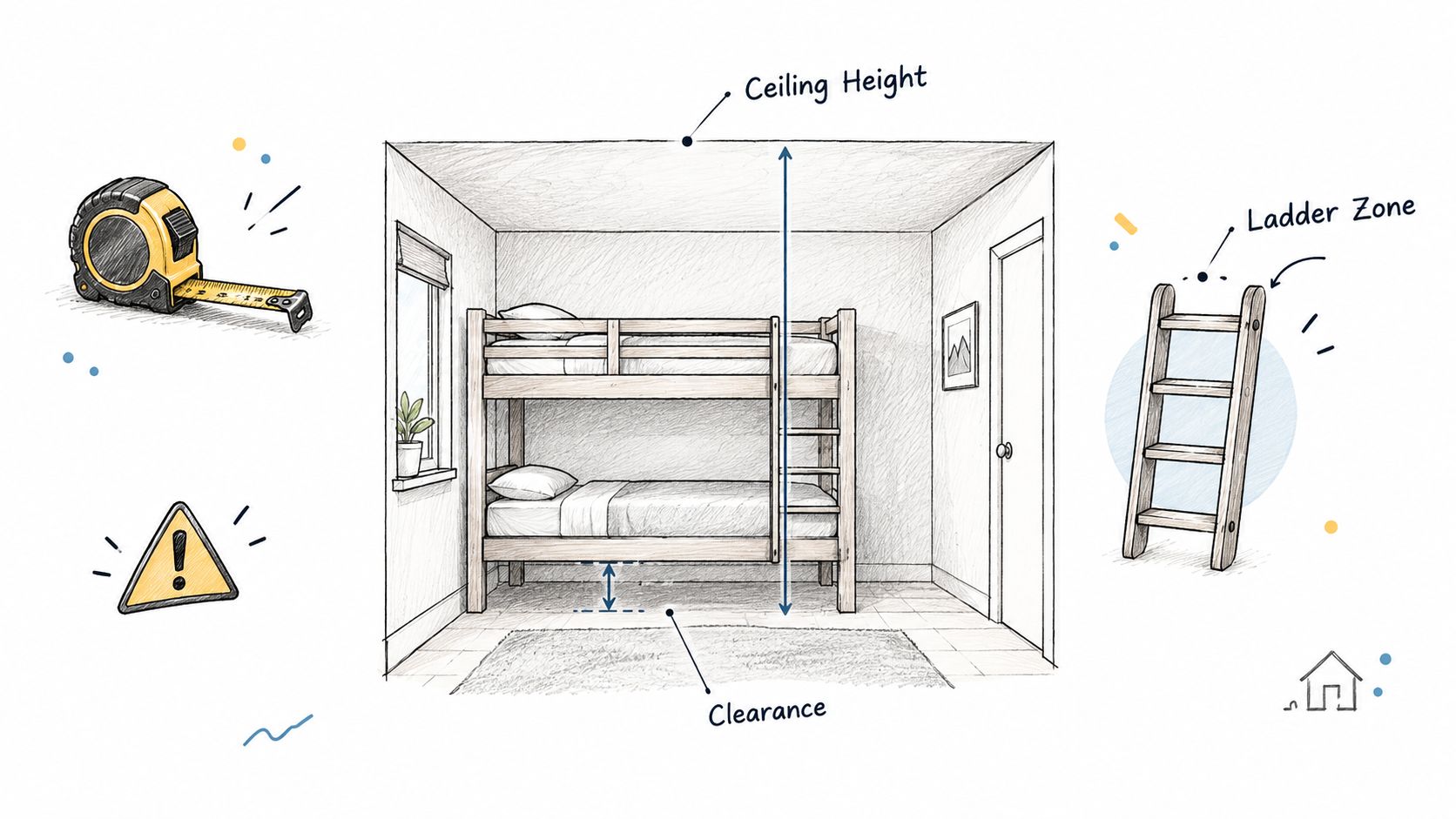
Start with a measured room, not a bed silhouette. Record ceiling slopes, windows, doors, vents, lights, outlets, and the route guests will use with luggage.
A wider sleeping surface doesn't solve a low ceiling. For bunk beds for ski homes in Park City, Heber, or Midway, an attractive space under an eave still needs a room-specific clearance review. The same applies to a beach condo with an awkward soffit.
Give the Builder a Usable Room Brief
Use Park City Bunk Beds' bunk bed dimensions planning resource to prepare your measurements, then request a drawing for the actual proposed configuration.
Vertical space: Show the finished mattress positions, lower-bunk sitting space, and upper-bunk ceiling relationship.
Access footprint: Draw the ladder or stairs with nearby doors and drawers open.
Room hazards: Identify fans, lighting, window coverings, cords, and projecting fixtures.
Daily use: Reserve space for bedding changes, luggage, and inspection.
Ask the builder to evaluate the intended occupants sitting up on each level. If the geometry doesn't work, revise the configuration rather than changing the approved mattress or guardrail arrangement.
Plan for the Guests You Actually Host
For family properties, Health Canada's bunk-bed guidance recommends guardrails around the upper bunk, a snug mattress fit without hazardous gaps, and no upper-bunk use by children under 6.
That operating decision belongs in the guest information as well as the design discussion. Don't leave families to infer suitability from a listing photo.
Good bunk room ideas balance sleeping arrangements with circulation. Triple bunk beds and quad bunk beds may deserve comparison, but only when their complete access and clearance plans fit. More mattress area isn't an improvement if guests can't comfortably use the room around it.
Starting Your Full Over Full Project with Park City Bunk Beds
Start your inquiry with room photographs, measured wall lengths, ceiling conditions, and the intended guest profile. Include mattress preferences, access needs, and whether the property is a coastal rental, mountain retreat, or family cabin.
Park City Bunk Beds offers custom sleeping configurations for these kinds of projects. Rather than requesting only a full-over-full price, ask for a proposal that identifies the materials, foundation arrangement, permitted use, finish system, access configuration, and installation responsibilities.
Bring the Decisions Into the Proposal
Room fit: Include awkward corners, ceiling slopes, and nearby furnishings.
Operating needs: Explain who maintains the property and how frequently guests change.
Appearance: Provide examples of the rustic, modern, or built-in look you prefer.
Whether you're comparing Utah bunk beds for a ski property or custom built bunk beds for a Florida condo, the buying standard should stay practical. Approve a bed you can understand, document, inspect, and maintain, not a rendering you like.
For a room-specific full-over-full solution, Park City Bunk Beds with Nationwide Delivery offers custom bunk beds for vacation homes, cabins, and rental properties. Send your room measurements, ceiling details, and photos to request a design consultation and quote that addresses the sleeping layout, access, materials, and finish.
Comments