

Twin Bed and Queen Bed Compared for Rental Floor Plans

You're trying to make one room do a lot of work. Maybe it's a beach condo where every bed has to earn its keep, maybe it's a ski cabin with grandparents, kids, and cousins cycling through, or maybe it's an Airbnb where the photos look fine but the sleep setup keeps capping bookings. In that situation, the twin bed and queen bed decision isn't a bedding preference, it's a floor-plan decision.
The wrong choice early in a project creates problems you can't fix later without tearing up the room. You end up fighting circulation, placing guardrails where they shouldn't go, or giving away sleeping capacity to a layout that looked good on paper but doesn't work for actual guests. A custom approach starts with the room first, then builds the sleep mix around how people will really use it.
A useful way to think about it is this, a queen is usually the better call for adult comfort, while twins win when flexibility, compactness, and multiple sleepers matter more. If you want a good outside reference on how add-on sleeping pieces can change a room's usefulness, the luxury trundle guide from Lewis and Sheron Textiles is worth a look because it shows how secondary sleep surfaces change planning decisions in tight spaces. The rest of this article breaks the decision into room fit, guest mix, safety, and turnover, so you can choose a layout that works.
Why Twin and Queen Decisions Define a Floor Plan
A rental room is not just a place to sleep. It also has to handle circulation, storage, cleaning access, and the way guests move through the space. Choose the bed first and the room second, and something gets squeezed out, usually a dresser, a clear walkway, or safe ladder access.
Capacity versus usable space
A queen bed gives adults more comfort, but it takes a real bite out of room width. A twin looks smaller, yet that smaller footprint can make room for two beds, a bunk system, or separate sleeping zones for guests who should not share a bed. Owners of vacation rental bunk beds usually need to approach the purchase the way a space planner would.
That choice looks different in each property. A beach condo that sleeps four with two queens has a different problem than a ski cabin where three kids share one room, or an Airbnb host trying to add beds without changing the footprint. A queen often fits the first case, twins usually fit the second, and a mixed custom layout often solves the third.
Practical rule: if the room has to do more than sleep one couple, choose the sleeping system first, then fit the mattress size around it.
A custom bunk builder does this by starting with the room, the ceiling height, and the guest mix. Park City Bunk Beds designs around the actual use case instead of forcing a standard frame into a room that cannot support it. If you are comparing mixed layouts, the idea of a queen-over-queen bunk configuration makes more sense once you see the occupancy problem in real terms.
A good outside reference on secondary sleep surfaces is the luxury trundle guide from Lewis and Sheron Textiles. It shows how a second sleep surface changes what a room can do without pretending every room has the same floor-plan limits.
The wrong bed size costs bookings before anyone complains about comfort. It can also force awkward guardrail placement, eat up storage space, and make the room feel cramped even when the mattress itself seems big enough.
Twin and Queen Dimensions in Real Numbers
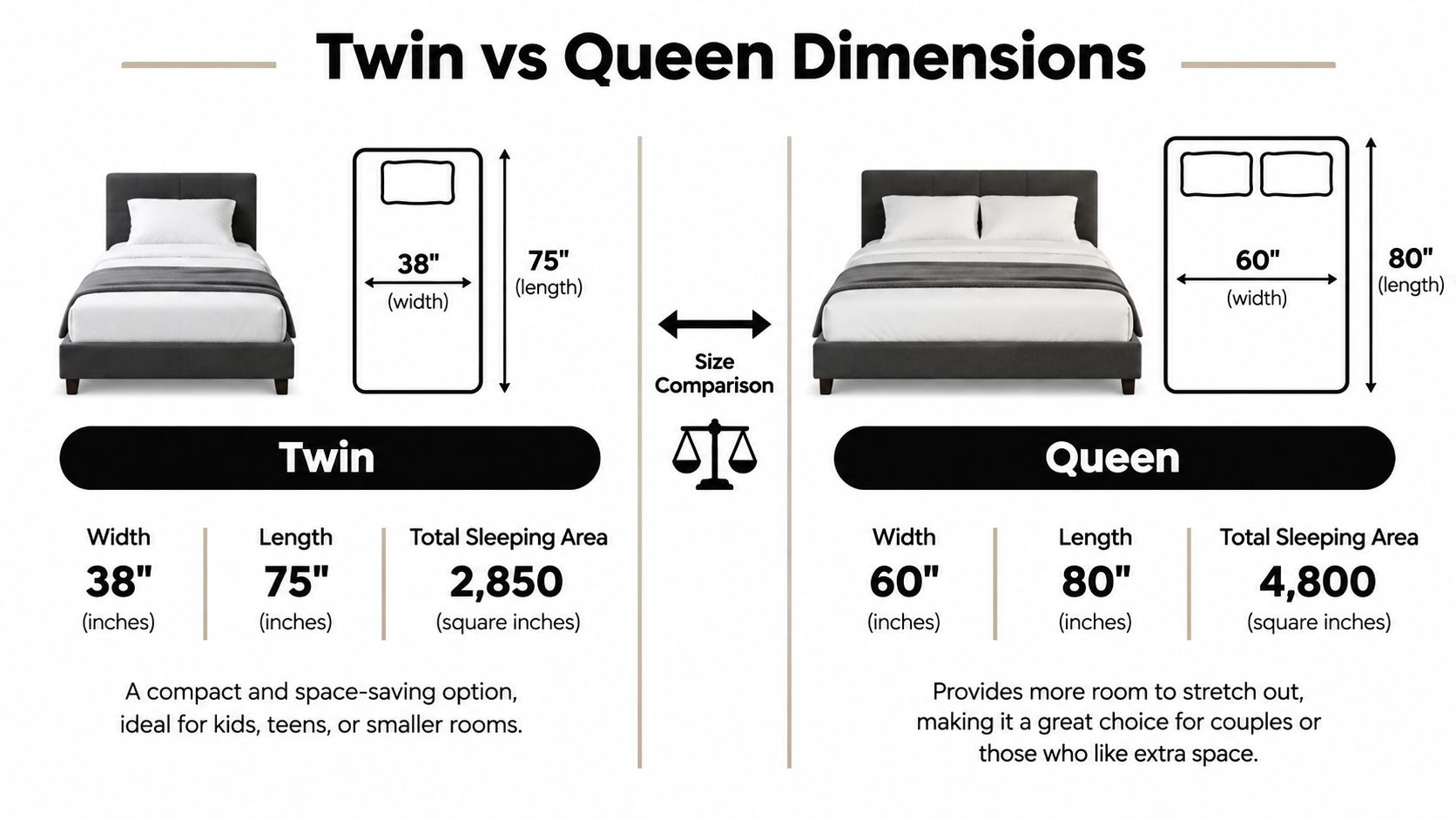
The numbers are straightforward, but the planning impact isn't. A standard U.S. twin mattress is about 38 by 75 inches, while a queen is about 60 by 80 inches. That gives the queen 22 inches more width and 5 inches more length, which is exactly why it feels materially better for couples and longer stays. Mattress sizes from Indian River is a helpful quick reference if you want to cross-check standard mattress categories before you start sketching a room.
Mattress area is only the starting point
A twin offers about 2,850 square inches of sleeping area, while a queen offers about 4,800 square inches, and that difference changes how guests move through the room. The twin is compact enough to support bunk-room layouts and independent sleepers, while the queen gives adults more shoulder room and less compromise overnight. One queen also uses roughly 33% more mattress area than two separate twins combined, which is why mixed layouts often beat a room full of queens when capacity matters.
The planning envelope matters even more than the raw mattress footprint. Using roughly 24 inches of clearance on accessible sides and about 30 inches at the foot, a twin needs about a 7 ft 2 in by 8 ft 9 in envelope, while a queen needs about 9 ft by 9 ft 2 in. That makes the queen's planning envelope about 39% larger by floor area under those assumptions, which is a real issue once you add ladders, stairs, guardrails, doors, and circulation routes. You can see more layout context in the Park City Bunk Beds dimension guide.
A queen is better when the room is built for comfort first. A twin is better when you need to fit multiple sleeping surfaces, preserve circulation, or keep the room flexible for future changes. Two twins placed side by side create a sleeping surface about 27% wider but 5 inches shorter than a queen, so they can solve certain rental layouts even when a single mattress can't.
The mattress number matters, but the clearances decide whether the room feels usable or awkward.
Here's the other detail that matters in custom work. Mattress dimensions can vary by roughly 1 to 2 inches between manufacturers, so don't anchor a build to a single perfect number. Measure the frame, not just the label.
Room Layouts for Twin, Queen, and Combinations
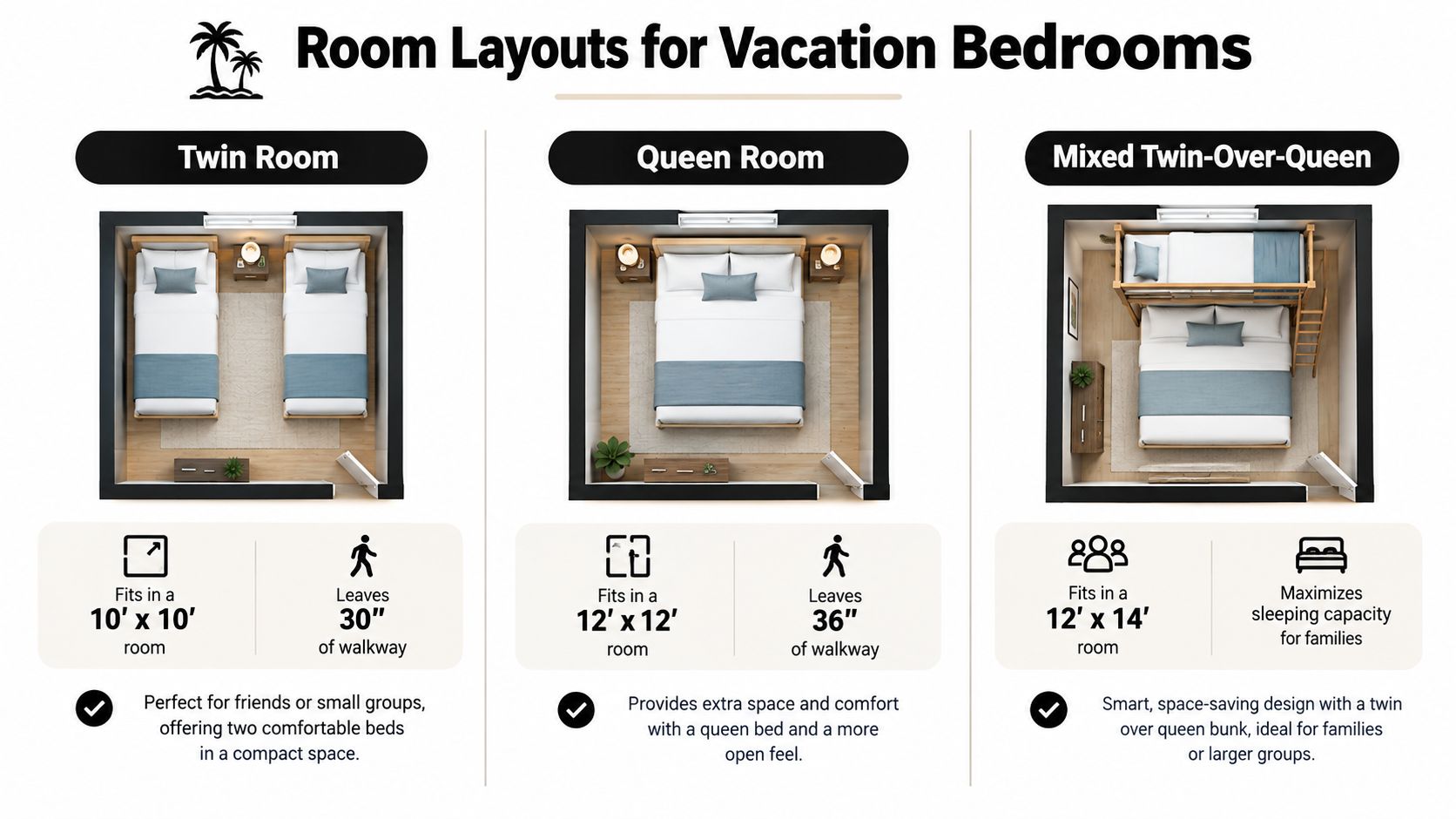
A small guest room, a mid-size bedroom, and a dedicated bunk room all reward different choices. A twin gives you room to breathe, a queen asks for more width, and a mixed configuration lets you spend the floor area on occupancy instead of empty space. That's why bunk room design is really a space allocation problem.
Small rooms need discipline
In a compact guest room, a queen can crowd out storage fast. The bed itself takes a bigger bite out of the floor, and once you add bedside access and circulation, the room can start feeling overbuilt. Twins are easier to place in rooms where you need to preserve a walkway, fit a dresser, or leave enough space for luggage and kids' gear.
Mid-size rooms are where mixed layouts shine
A room that can handle a queen doesn't always need one. If the property serves families, a custom system can mix sizes so adults get a queen and kids get twins in the same footprint. That's why configurations like bunk beds for small rooms often outperform a standard bedroom setup, because the room works harder without feeling jammed.
A typical mid-size bedroom can also support a built-in look, which matters in vacation rental bunk beds where the goal is to feel polished, not improvised. A twin-over-queen or queen-over-queen arrangement can turn one room into a real sleeping suite instead of just a place with beds in it.
Clear takeaway: if the room is wide enough for a queen but not generous enough for one plus storage, a mixed custom bunk system usually makes better use of the footprint.
That's where custom bunk beds separate themselves from mass-produced frames. They're built around ceiling height, wall spans, stair locations, and room shape, not around one fixed product size. For Park City, Heber, Midway, and other mountain or coastal markets, that flexibility is often the difference between a decent room and a bookable one.
Sleeping Capacity Scenarios for Rental Groups
Guest mix decides the layout faster than style ever will. Couples want a real queen, families want to avoid wasting rooms, and unrelated adults usually want separate beds. Once you match the group to the sleeping setup, the right floor plan becomes obvious.
Guest scenario | Best bed mix | Resulting configuration | Capacity win |
|---|---|---|---|
Couple on a long stay | Queen | One queen in a primary bedroom | Better adult comfort |
Two adults with children | Twin and queen mix | Twin-over-queen or queen plus twin | Keeps adults and kids in one room |
Three-generation family | Mixed layout | Queen-over-queen or queen-plus-twin setup | Gives older guests a real bed and preserves flexibility |
Unrelated adult guests | Twins | Two twins or twin-over-twin bunks | Separate sleeping surfaces |
Large family rental | Multiple twins | Triple or quad bunk room | More sleepers in one footprint |
A room with one queen often leaves family rentals short on capacity. Two twins, or a twin-over-twin bunk, can free another bedroom for storage, luggage, or a different guest group. That matters in vacation rental bunk beds and quad bunk beds for vacation rentals because the room has to earn its keep. A queen-only room can also frustrate couples and older relatives if they are stuck on twins for more than a night or two.
Think in booking combinations, not just mattress counts
A queen-over-queen or queen-plus-twin setup handles mixed-age groups without forcing everyone into the same bed type. Larger homes use that kind of arrangement to keep occupancy high while still making the listing read like a real bedroom count, not a pile of mattresses.
The better choice is the one that protects the guest relationship that matters most. If the property serves couples, lead with queen-heavy rooms. If it serves families, siblings, cousins, and group trips, twins and mixed layouts give you more flexibility from one booking to the next. A property with the wrong split wastes space, and wasted space is lost revenue.
Safety, Guardrails, and the Bunk Threshold
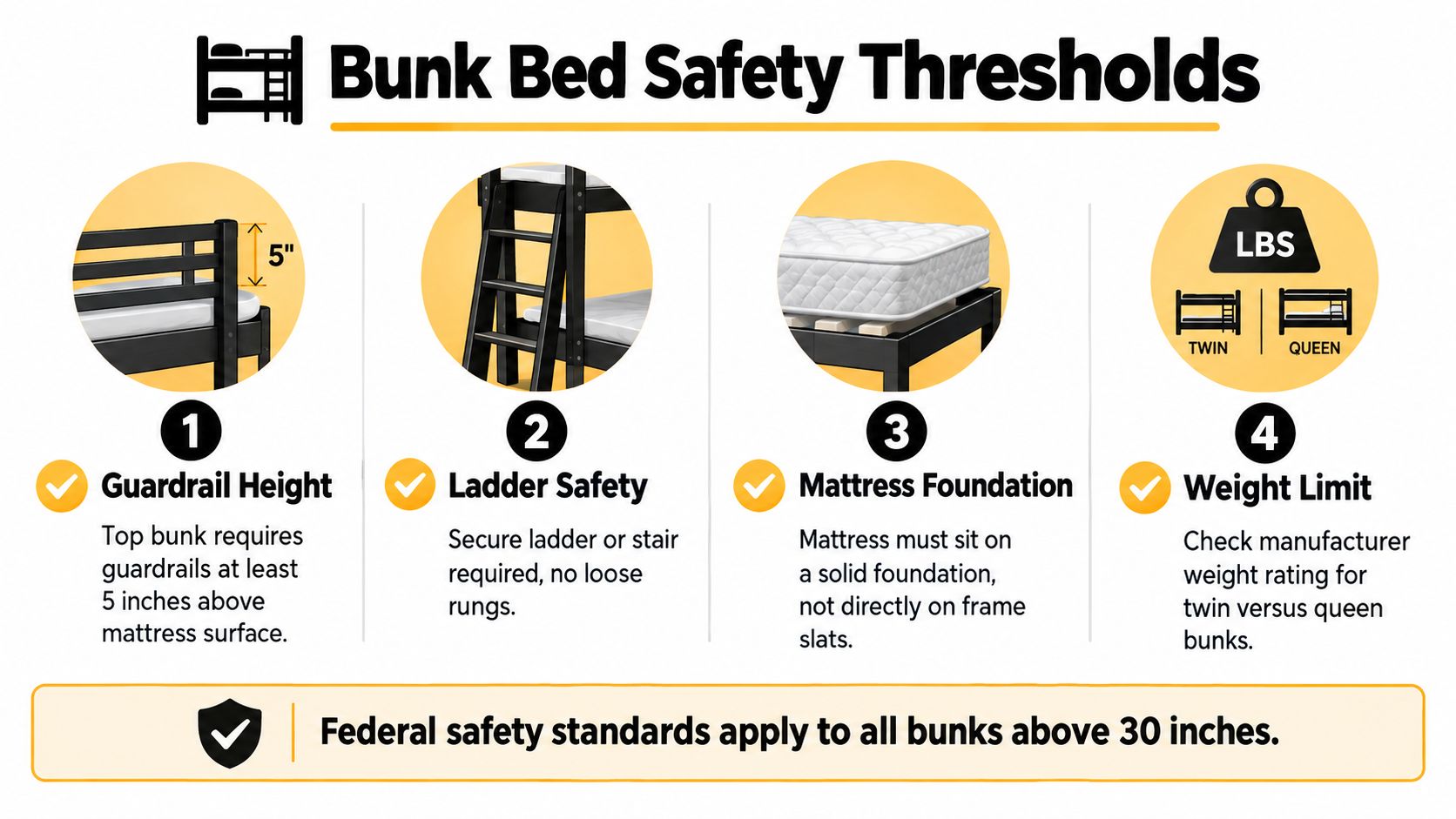
Once a mattress foundation rises above the floor, you're no longer in ordinary bedroom territory. Under the federal bunk-bed standard, a bed qualifies as a bunk bed when the underside of its mattress foundation is more than 30 inches above the floor, and the upper sleeping surface needs two guardrails, one on each side. The rule is about the structure, not the mattress label, so a queen on top follows the same basic requirement as a twin on top. CPSC bunk bed guidance makes that threshold clear.
Check the whole system, not just the mattress size
The openings around the upper bunk matter just as much. CPSC guidance says openings in the upper-bunk structure must be less than 3.5 inches to prevent a child's torso from passing through, and the wall-side guardrail must be continuous, with any gap between the rail and the end structure limited to 0.22 inches. That means ladders, end panels, rails, and support parts all need to work together.
Custom bunk rooms need a real review. A finished foundation height can change once you account for the frame, support system, mattress thickness, and floor conditions. If you're planning a built-in bunk bed or an adult bunk bed system, don't guess on the finished height, because the rule is triggered by the final installed position, not the drawing on paper.
If the upper sleeping surface goes above the threshold, treat the whole unit like a safety system.
For owners, the practical checklist is simple. Verify the finished foundation height, plan guardrails before selecting mattress thickness, place ladders where guests can use them, and leave enough room for safe movement around the unit. Bunk beds for family cabins, ski homes, and beach houses should always be designed as complete systems, not as a mattress size with rails added later.
Turnover Realities for High-Occupancy Rentals
The cleaning side changes the bed decision fast. Family accommodation research says cleanliness and sanitation are the leading selection factor for 68% of U.S. family travelers, while safety and security rank at 54%. That's why bed layout affects reviews, not just comfort, especially in vacation rental bunk beds where guests pay attention to every detail. Family Travel Association survey report is useful here because it shows what families care about when they book.
One queen is simpler, but twins reset better
A queen reduces the number of mattresses, sheets, and bed-making tasks per occupied sleeper. That can help turnover when the room is mostly for couples, but it also concentrates wear and makes bulky bedding harder to wash, fold, and stage. A twin setup does the opposite, it gives you more reconfiguration options, but it also creates more seams, rails, ladders, and touchpoints to inspect.
That's why housekeeping and operations should be part of the design conversation from day one. A room that's easy to reset after every checkout usually performs better than a prettier room that slows the cleaning team down. The right layout also helps with accessibility, because clear pathways and predictable bed heights make the room easier to manage for guests with mobility limits.
A good turnover checklist for this kind of room is short and practical.
Washable encasements: Use covers that can be removed and laundered without a hassle.
Accessible clearances: Make sure staff can reach the bed edges and inspect under and around the frame.
Guardrail inspection: Check every rail, ladder, and fastener on stacked beds.
Bedding standardization: Keep the sizes consistent so the team isn't hunting for the right set.
Mobility access: Confirm the layout still works for guests who need wider paths or simpler entry.
Cleaning rule: if a bed mix makes the room harder to reset, it's probably wrong for a high-occupancy rental.
That's where custom built bunk beds earn their place in a rental property. Park City Bunk Beds can build layouts that account for turnover realities, not just sleeping counts, which matters in busy beach markets and mountain rentals where every checkout has to be handled quickly and cleanly.
Twin-Over-Quin and Other Mixed Configurations
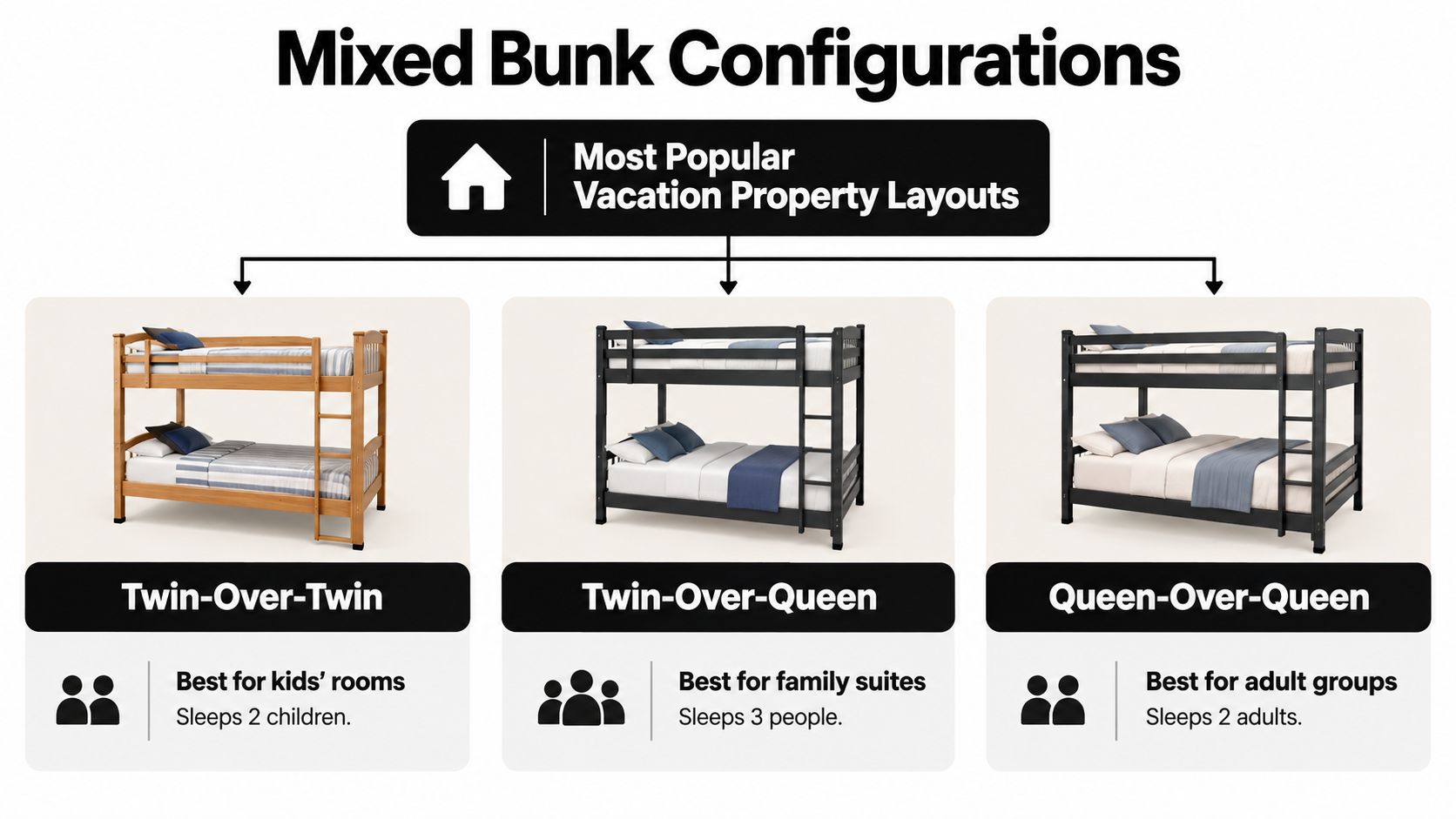
Most high-performing vacation properties don't settle on a pure twin room or a pure queen room. They land somewhere in the middle, because mixed layouts let the room serve different guest groups without wasting space. That's why custom bunk beds for vacation homes are so effective when the property needs both comfort and capacity.
Pick the mix that matches the room and the guest
Twin-over-twin works well in kids' rooms and compact bunk rooms. Twin-over-queen is the move for family suites where adults need the better bed and children need the flexible upper or lower surface. Queen-over-queen makes sense for adult groups that want separate large sleeping surfaces in one footprint, especially in lodges, coastal rentals, and larger family retreats.
Ceiling height affects every one of those choices, because stacked layouts need real headroom, not just a pretty sketch. Stairs can replace a ladder when the room has enough width, and trundles help when you need a backup surface without changing the main layout. Under-bed storage becomes more valuable when the room has to handle luggage, toys, or extra bedding.
If you're building for recurring rental use, think in configurations, not products. Triple bunk beds and quad bunk beds are better described as room solutions than furniture purchases, because they solve the space problem in a way off-the-shelf frames rarely can. That's also why custom built bunk beds tend to fit beach houses, ski homes, and family cabins more naturally than standard bedroom sets.
The strongest layouts usually do two things at once, they raise occupancy and keep the room feeling intentional. That's the point of mixed configurations, and it's why a thoughtful bunk room often outperforms a room full of queens.
Choosing the Right Setup for Your Property
Start with the guest mix, then work backward to the room. If you host couples and longer stays, use queens where the room can support them. If you need flexibility, independent sleepers, or mixed-age groups, twins and bunk systems usually give you a better result.
The implementation details matter just as much as the layout. Verify the finished foundation height, leave about 24 to 30 inches of circulation where people need to move, standardize bedding, and confirm guardrail placement on every upper sleeping surface. If the room has to serve adults and kids at the same time, a custom mixed configuration is usually the smartest path.
For vacation rental owners, ski homes, beach houses, and family cabins, the best move is to design the room around real use instead of around a catalog frame. That's how you get a room that books well, cleans well, and still feels comfortable after repeated stays.
Park City Bunk Beds with Nationwide Delivery builds custom bunk beds and mixed sleeping layouts for vacation rentals, cabins, and family properties that need more than a standard frame. If you're planning a room around twin beds, queen beds, or a custom mix, visit Park City Bunk Beds with Nationwide Delivery to request a quote and map the layout to your actual space.
Comments