

Bunk Beds with a Pull Out Bed: Guide for Vacation Rentals

A Florida condo can look ready for guests on paper and still fail the moment the trundle rolls out, the suitcase lands by the door, and nobody can get to the closet. That's the actual test for bunk beds with a pull out bed, especially in vacation rentals where one room has to do more than sleep people. The right setup gives you extra capacity without turning bedtime into a furniture shuffle.
That balance is exactly why many hosts end up looking at custom bunk beds instead of another mass-produced frame. A pull-out bed can be a smart solution, but only if the room still works when it's fully deployed, not just when it's staged for photos. For hosts who already juggle turnovers, linen swaps, and occupancy planning, even small design choices matter, which is why operational tasks like outsourcing bookkeeping for rental hosts often go hand in hand with smarter space planning.
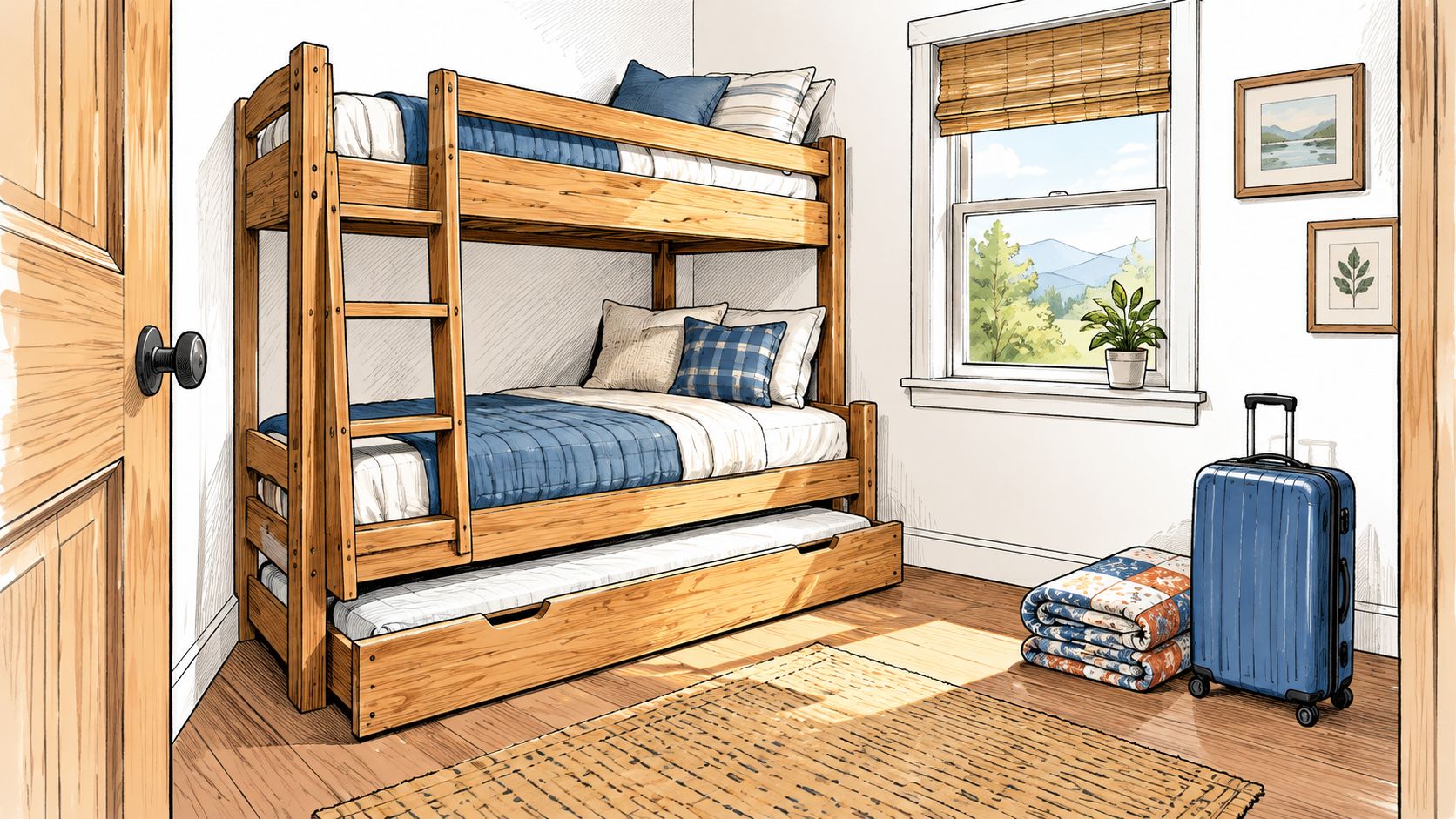
Park City Bunk Beds' vacation rental bunk beds are built around that same idea, sleeping capacity has to work with the room, not against it.
Why Bunk Beds with a Pull Out Bed Matter for Vacation Rentals
A host with a tight condo bedroom usually isn't shopping for furniture first, they're trying to solve a flow problem. One guest wants the trundle out, another needs to open a closet, and housekeeping still has to move through the room without dragging a bag over the walkway. That's where vacation rental bunk beds either earn their keep or create friction.
The room has to work in both modes
A bunk room that looks efficient when the trundle is stored can become awkward the moment it's open. The key question is whether guests can extend the bed, open drawers, walk past luggage, and still reach the door and ladder without rearranging the room. If the sleeping setup only works when everything is tucked away, it's not really saving space, it's borrowing it from bedtime.
Practical rule: judge the room by its deployed footprint, not the marketing photo.
In rental properties, that matters because guests don't use furniture like owners do. They arrive late, bring more bags than expected, and don't always know where the trundle is supposed to stop. A pull-out bunk that supports smooth circulation reduces the chance that the space feels crowded the first time it's used.
Good planning starts with the actual sleep setup
The stored size matters, but the extended size decides whether the room functions. Measure where the trundle lands, where door swings land, and whether someone can still reach a dresser or the bathroom without sidestepping furniture. In a compact condo, a narrower fixed bunk with better circulation can feel more usable than a larger bunk-plus-trundle combination.
That's also where a custom build helps. Built-in bunk beds and custom built bunk beds can be designed around the room's exact layout, not around a generic footprint. In mountain homes, ski properties, and bunk beds for Airbnb listings, that difference often decides whether the room feels polished or cramped.
What works better than it sounds
A trundle can add sleeping capacity, but it shouldn't force the whole room to stop functioning. The stronger choice is usually the one that keeps a clear walkway, allows easy housekeeping access, and still gives guests enough room to unpack. For hosts managing frequent turnover, that's a practical advantage, not just a design preference.
How Trundle Mechanisms Work in Bunk Systems
A trundle isn't just an extra mattress hidden under a bed, it's a moving part that has to work smoothly every time a guest pulls it out. The mechanism matters because a trundle that feels easy in a showroom can bind, scrape, or block the room once it's loaded and used repeatedly. For bunk room design, that's a mechanical issue, not a styling detail.
The video below is useful if you want to see the motion of a pull-out setup in a real bed system.
The three common movement styles
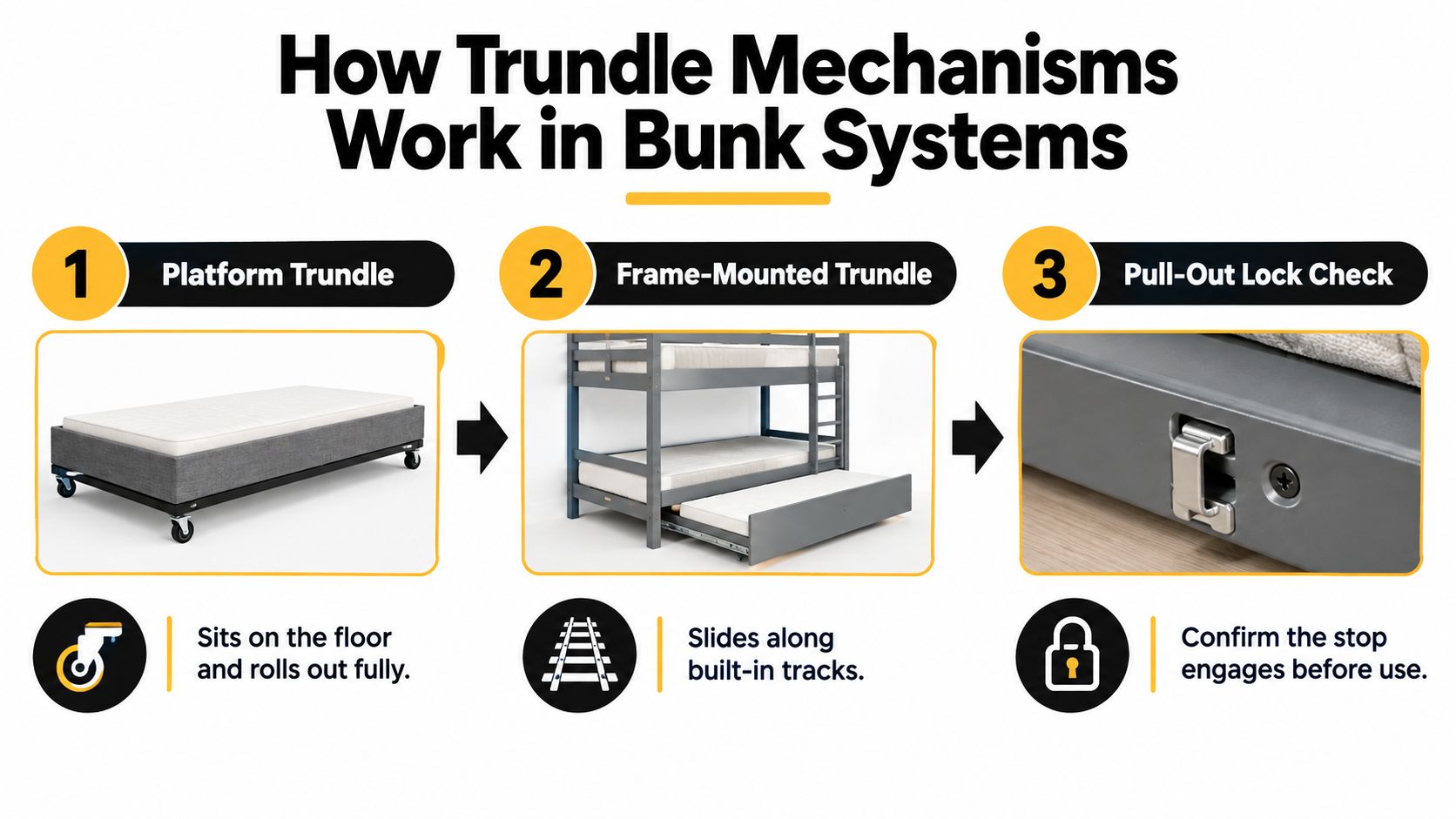
A platform trundle sits low and rolls out on casters. It's simple, but it depends on a clear, level path and enough room for the mattress to clear nearby furniture. A frame-mounted trundle rides on built-in tracks or rails, which can feel more controlled when the hardware is designed well. A pull-out system also needs a lock or stop so the bed doesn't drift once it's open.
A trundle should feel like a planned extension of the bunk, not a loose accessory under it.
The hardware you don't see matters as much as the visible bed frame. Wheels, slide rails, and stop points affect how easily the trundle comes out, how quietly it moves, and whether it stays aligned after repeated use. In high-turnover rentals, predictable motion is more valuable than a clever mechanism that needs constant adjustment.
Clearances matter more than brochure dimensions
A trundle can look compact while stored and still dominate the room when extended. That's why it helps to measure both the closed footprint and the open footprint before committing to a layout. Check whether the pulled-out bed blocks the closet, the hallway, or the path to the bathroom, because those are the moments guests notice immediately.
For owners comparing custom bunk beds and mass-market frames, the biggest difference is often how the system behaves under real use. A good design lets the lower bed roll out without lifting, fighting, or dragging against the main frame. If that bed has to be manhandled every time someone sleeps on it, it's going to wear out faster and frustrate guests.
Match the mechanism to the property
A light guest-room trundle might be fine in a low-use space. A rental that sees families, luggage, and repeated setup needs something sturdier and easier to inspect. That's why adult bunk beds and higher-use resort setups should treat the trundle as part of the structure, not just a hidden mattress slot. If you want to see a configuration that's built for heavier use, Park City Bunk Beds' adult bunk beds page is a useful place to compare options.
Trundle Configuration Comparison for Rental Use | Best For | Maintenance Considerations |
|---|---|---|
Platform trundle | Simple layouts and occasional guest use | Check wheels, floor clearance, and alignment often |
Frame-mounted trundle | More controlled motion in higher-use rooms | Inspect rails, stops, and fasteners regularly |
Pull-out with lock stop | Rentals where predictable positioning matters | Confirm the stop engages cleanly every time |
Choosing the Right Trundle Configuration for Heavy Use
Not every pull-out bed belongs in a rental that gets full-house turnovers, luggage drag, and repeated guest handling. Some systems are fine for a spare room, but they feel too light once adults start using them every weekend. For heavy-duty bunk beds, the question isn't whether the trundle exists, it's how the load moves through the whole structure.
Look at the load path, not just the mattress
A good trundle carries weight through a clean path from the mattress to the frame, then into the floor. If the trundle relies on shared support members that are hard to inspect or hard to service, maintenance gets messy fast. That's one reason custom built bunk beds tend to outperform off-the-shelf designs in vacation homes, because the frame, fasteners, and moving parts can be planned together.
Some configurations are better for bedrooms that will see adults, teens, or mixed-age groups. Others are better for occasional guests who don't mind a lower-profile sleeping surface. The wrong choice usually shows up as noise, wobble, or a bed that feels fine when empty and less fine after a few seasons of use.
Compare the practical trade-offs
A light-duty trundle may be easier to store, but it can also be more sensitive to overloading and more likely to loosen over time. A commercial-style mechanism usually feels more stable, though it may cost more in complexity and require tighter installation. The right answer depends on whether you're furnishing a beach condo, a ski cabin, or a family reunion house where the extra bed will be used often.
If the room hosts adults, build the pull-out system like equipment, not decor.
Use the comparison below to think through the trade-offs by property type.
Configuration Type | Best For | Maintenance Considerations |
|---|---|---|
Lightweight guest trundle | Low-traffic guest rooms | More frequent checks for wear and movement |
Reinforced pull-out trundle | Vacation rentals with regular guest turnover | Inspect fasteners, guides, and support points |
Heavy-duty integrated trundle | Adult use and higher-occupancy properties | Confirm quiet operation and predictable alignment |
Quiet use matters in rentals
Noise is a real operational issue in short-term stays. A trundle that squeaks, catches, or shifts is more than annoying, it makes the bed feel less dependable. If guests have to wrestle the lower bed into place or guess whether it's seated properly, the furniture isn't doing its job.
That's why high-use properties benefit from a stronger, more intentional build. The frame needs to stay stable during deployment, and the pull-out bed needs to open without interfering with the main sleeping structure. In bunk beds for vacation homes, that reliability helps protect both guest comfort and the property's furnishings.
Mattress Sizing and Guardrail Safety Rules
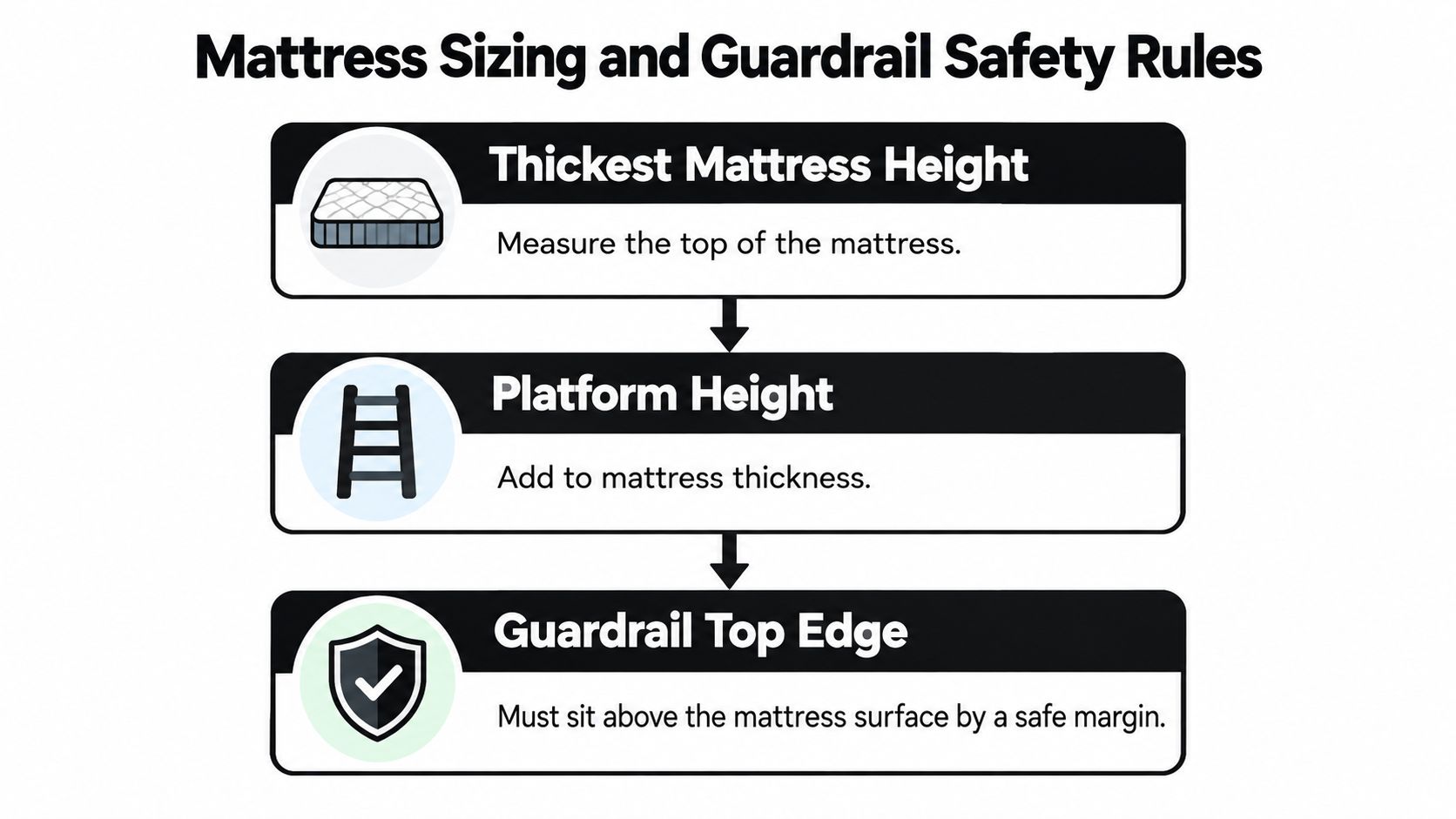
Mattress choice is a safety decision on an upper bunk, not just a comfort decision. The thickness you select changes the effective guardrail height, which means a replacement mattress can subtly alter the protection the bed was built to provide. In rentals, where guests may expect to bring toppers or substitute bedding, that matters a lot.
Measure the mattress against the guardrail
The top edge of the guardrail has to sit above the mattress surface by a safe margin, and that margin should be judged against the thickest approved mattress. If the mattress gets thicker, the rail gets effectively shorter. That's why mattress specifications should be fixed in writing, not left to guesswork at check-in.
A lower pull-out bed is different. If its mattress foundation stays at a lower floor-relative height, it isn't automatically treated like an upper bunk. The distinction matters because a trundle bed can be comfortable and useful without carrying the same guardrail expectation as the raised sleeping level above it.
Keep the mattress spec with the bed
For rental use, the bed should tell the guest what belongs on it. That means the mattress thickness should be documented on the frame or in guest instructions, and the manufacturer's guidance should stay with the furniture. A house manual, turnover checklist, or permanent label helps prevent the wrong mattress from ending up in the wrong place.
Practical rule: the mattress, platform height, and guardrail dimensions should be specified together.
That's especially important for adult bunk beds in vacation rentals. Adults don't always sleep on the exact mattress originally supplied, and a thicker replacement can reduce the safety margin more quickly than most owners expect. The safest approach is to choose the mattress and rail system as one design package, not as separate purchases made months apart.
Don't treat the trundle like a spare bed with no rules
The pull-out bed may sit lower, but it still needs a sensible mattress fit and a clear operating plan. Keep the lower sleeping surface from becoming a storage spot, and make sure the trundle can't be left partially extended where it becomes a pinch point or obstacle. In a busy rental, those small details are part of the design, not afterthoughts.
For dimension planning, Park City Bunk Beds' bunk bed dimensions guide is a helpful reference when you're mapping mattress thickness, platform height, and rail placement together.
Federal Safety Standards and Rental Risk Management
Federal safety rules matter here because bunk-bed risk isn't limited to a single age group or a single type of product. The CPSC developed the bed entrapment standard after documenting serious hazards involving openings between guardrails, mattress foundations, bed ends, walls, and structural components. In its review covering a recent 9.6-year period, the agency received reports of 57 deaths involving children under age 15 who became trapped between an upper bunk and a wall or in openings within the bed structure, and more than 96% of those fatalities involved children age 3 or younger. The standard applies to adult bunk beds under 16 CFR Part 1213, while children's bunk beds are also addressed under Part 1513. CPSC bunk-bed entrapment standard
Historical recalls show two separate risks
The CPSC's petition and review also estimated 4,600 emergency-department-treated injuries associated with bunk-bed entrapments in the United States from 1990 through 2012, with a 95% confidence interval of approximately 3,500 to 5,700 cases. The same review identified 50 consumer-level bunk-bed recalls, including 24 after the federal standard became effective. Among those post-standard recalls, 13 involved entrapment hazards affecting 96,105 bunk beds, while 11 involved collapse, falling, or structural defects affecting 535,420 beds. CPSC bunk-bed petition review
That split matters for rentals. One risk lives in openings and rail geometry, the other lives in the structure itself. A pull-out trundle adds another moving component, so the full system has to stay stable, aligned, and easy to inspect over time.
Treat the trundle as an engineered element
A trundle isn't just extra capacity, it's part of the load-bearing setup. The deployment surface should be level, the opening should be clear, and the bed should have positive stops that keep it where it belongs. If the pull-out section shifts, dips, or creates pinch points at the main frame, the design is too loose for high-turnover use.
The upper sleeping surface also needs to be thought of as a regulated upper bunk when its foundation is more than 30 inches above the floor. CPSC guidance requires at least two upper guardrails, with one on each side, and the guardrail top must extend at least 5 inches above the thickest manufacturer-recommended mattress. CPSC bunk-bed guidance
Age guidance should be visible and simple
The CPSC test manual says children under 6 years of age should not use the upper bunk. That warning doesn't disappear just because there's a trundle below it. In a family rental, the age guidance should be obvious to guests, especially if the house is filled with people who've never used the bed before. CPSC bunk-bed test manual
For hosts in mixed-use properties, structural strength, child-safety compliance, and guest-use rules need to be handled as separate questions. A bed can be strong enough for adult use and still fail on guardrail geometry, or meet a basic rail rule and still be a poor choice for a high-traffic rental. That's why a verification checklist is more useful than a vague “heavy-duty” label.
Building a Bunk Room Plan That Supports Rental Operations
A good bunk room doesn't just add mattresses, it improves how the whole property works. The strongest setups make it easier to host larger groups, keep walking paths open, and reduce the friction that comes with turnover. That's why well-planned bunk room ideas are often more valuable than just adding another bed to a corner.
Build around real occupancy, not just capacity
A room should be planned for how guests move through it. If the trundle has to be opened every night, the room should be designed so that action doesn't block the door, the dresser, or the path to the bathroom. If the property is a ski home, beach house, or family cabin, the same logic applies, because boots, luggage, and wet gear all compete for floor space.
For small-room planning, multi-functional furniture for small rooms is a helpful reminder that every piece in the room should earn its place. A bunk with a pull-out bed can work beautifully when it's part of a broader plan that includes storage, circulation, and housekeeping access.
Make the room easy to maintain
The best rental setups are the ones staff can reset quickly. That means the bed should be easy to deploy, easy to inspect, and easy to explain to guests. Permanent mattress specs, clear guest instructions, and a predictable pull-out mechanism reduce confusion during busy turnover windows.
Park City Bunk Beds with Nationwide Delivery designs custom bunk beds, built-in bunk beds, triple bunk beds, and quad bunk beds for property owners who need a better fit for their room shape and ceiling height. Those configurations are especially useful in bunk beds for ski homes, bunk beds for beach houses, and other high-occupancy spaces where style and durability both matter.
Choose the version that fits the property
Some rooms are better served by a strong fixed bunk with open circulation. Others need a lower pull-out bed for families, cousins, or mixed guest groups. The right answer depends on who stays there, how often the bed opens, and how much movement the room has to absorb.
For owners comparing rustic bunk beds and modern rustic bunk beds, the style choice should come after the layout works. If the room functions well, the finish and built-in look can improve the whole property. If it doesn't, the prettiest bunk system still creates daily friction.
If you're planning a bunk room for a rental, cabin, or beach property, Park City Bunk Beds with Nationwide Delivery can help you size the room, choose the right configuration, and build a heavy-duty custom system that fits the way guests use the space. Visit Park City Bunk Beds with Nationwide Delivery to request a quote and compare custom bunk room options for your property.
Comments