

Bunk Bed with Ladder: Types, Safety, and Smart Choices

A bunk bed with ladder looks simple in a photo. In a real rental, cabin, or guest room, that ladder becomes the part people touch every night, every checkout, and every housekeeping turnover. If the bed is going into a vacation rental, adult bunk room, or a tight second-home layout, the ladder choice can matter more than the wood finish.
I see this most clearly when owners compare two rooms that look nearly identical on paper. One room gets a basic straight ladder because it saves space. The other gets a better-placed, better-attached access system that's easier to climb in low light and easier to live with during turnover. The first room often looks cleaner in listing photos, but the second one usually ages better because guests use it more naturally and staff do less awkward maneuvering around it.
That difference is why custom bunk beds are different from furniture-store bunk beds. You're not just buying sleeping capacity, you're deciding how people will climb, turn, carry bags, and use the room for years. For Park City bunk beds, Utah bunk beds, and rental properties that need to sleep more guests without feeling cramped, ladder design is an engineering choice, not a decoration choice.
Why the Ladder Is the Decision Most Buyers Underestimate
Two nearly identical coastal rentals can expose the difference fast. In one Florida property, the owner picked a narrow ladder because it looked minimal and kept the room open. In the other, the builder coordinated the ladder with the bunk frame so it felt steady, easy to find in the dark, and less annoying when sheets had to be changed mid-stay. The rooms photographed similarly, but the day-to-day experience did not.
The ladder is part of the operating system
A bunk bed with ladder isn't just a frame plus access. The ladder changes how guests enter, how much floor space stays usable, and how much stress gets transferred into the frame over time. In vacation rental bunk beds, those choices affect housekeeping, guest comfort, and how durable the bed feels after repeated use.
The practical mistake is thinking the ladder is a finishing touch. It's one of the most-used parts of the whole system, especially in rentals where guests arrive tired, carry luggage, and climb in low light. That's why custom builds for bunk beds for Airbnb, beach houses, and cabin rooms need the ladder planned with the room, not added after the fact.
Practical rule: if the ladder feels like an afterthought during the design conversation, it'll probably feel like an afterthought every night the bed is used.
The same room can also fail in two different ways. A ladder that saves space but feels steep can be annoying for adult guests. A ladder that feels comfortable but steals walking room can make a bunk room feel smaller than it needs to be. The better answer depends on who's sleeping there, how often they'll use it, and what the room has to do besides hold a bed.
The Main Ladder Types and How They Actually Perform
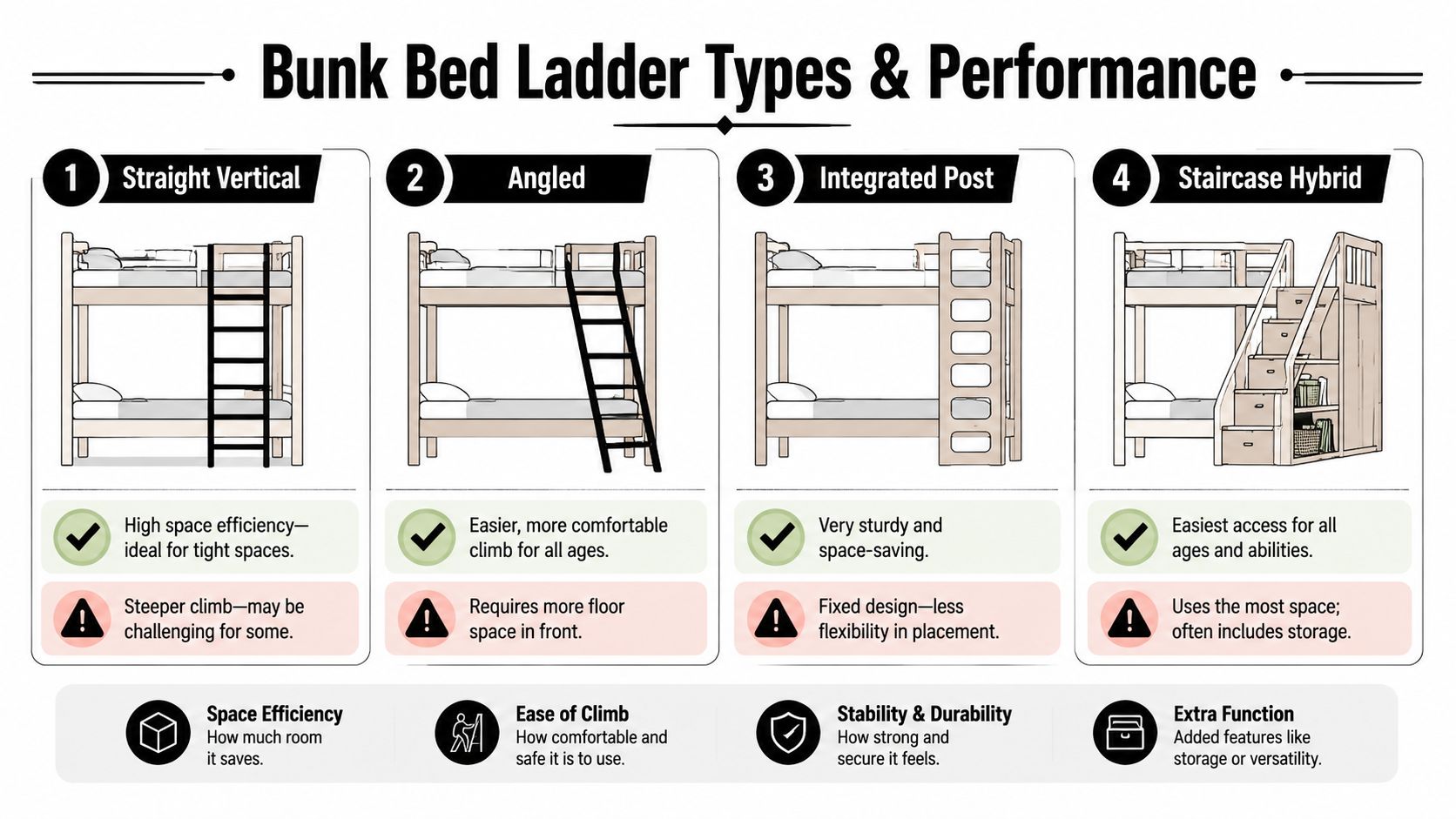
Straight vertical ladders
A straight ladder uses the smallest footprint, which is why it shows up so often in compact custom built bunk beds and tighter guest rooms. It's efficient, visually clean, and easy to fit when you're trying to preserve walking space or place two bunks in one room. The trade-off is that it feels steeper, especially at night or for taller adult guests who don't want to shimmy up one foot at a time.
Angled ladders
An angled ladder usually feels more forgiving. It gives the foot a more natural path, and that matters in bunk room design where the room serves adults, teens, and family groups using the bed in dim light. The downside is simple, it consumes more floor space than a straight ladder, so it needs more room to work without blocking circulation.
Integrated post ladders
An integrated ladder built into the bunk post can be a strong choice when the build needs a more permanent, built-in look. It often reads cleaner in a finished room and can feel very secure if the connection is solid. The drawback is flexibility, because once that access path is built into the frame, you're committed to the layout.
Staircase hybrid access
A staircase-style ladder gives the easiest climb and the most comfortable access for frequent use. It also takes the most room, which is why it tends to work best in larger bunk room ideas or in rooms designed to sleep many guests. In rental use, it can make a bunk room feel more premium and easier to operate, but it's only worth it when the floor plan can absorb it.
The right ladder type usually matches the guest profile before it matches the décor. If the room is for short-term turnover, adult guests, or repeated use, comfort and stability matter more than minimal visual footprint.
For hardware-minded buyers, the important companion detail is how the ladder is fastened and finished. Park City Bunk Beds hardware details are relevant here because ladder performance depends on the connection as much as the shape.
Ladder Placement and How It Shapes the Room
Placement changes how the whole room works. An end-mounted ladder can keep the center of the room open, which helps when you need a straight walkway or want to add another bunk nearby. A side-mounted ladder may fit a narrow room better, but it can interfere with a nightstand, a window, or the swing of a closet door. Front-mounted access is less common in custom layouts, but it can work when the room has a clear approach path and the bunk is meant to become a focal point rather than disappear into the corner.
Ladder Placement Trade-Offs in a Custom Bunk Room | |||
|---|---|---|---|
Placement | Room Footprint | Best Use Case | Watch Out For |
End-mounted | Usually preserves the main walkway | Shared rooms and tighter layouts | Can compete with walls, outlets, or a second bunk |
Side-mounted | Depends on adjacent furniture clearance | Long rooms with one open side | Can crowd windows, doors, or bedside access |
Front-mounted | Often needs the most clear approach space | Open bunk rooms and custom feature walls | Can make the room feel narrower if the entry path is busy |
A buyer usually notices the finish first and the placement later. That's backwards. The ladder's location decides whether the room feels open, whether two bunks can live together in the same space, and whether a guest can get in and out without turning sideways. In built-in bunk beds and modern rustic bunk beds, ladder placement has to be planned with the full room, not just the frame.
The best rooms make the ladder disappear into the circulation pattern. The worst rooms make people step around it every time they cross the floor. That's why placement can matter more than style, especially in bunk beds for vacation homes where the room has to serve real people, not just a staging photo.
Safety Standards That Actually Govern Bunk Bed Ladders
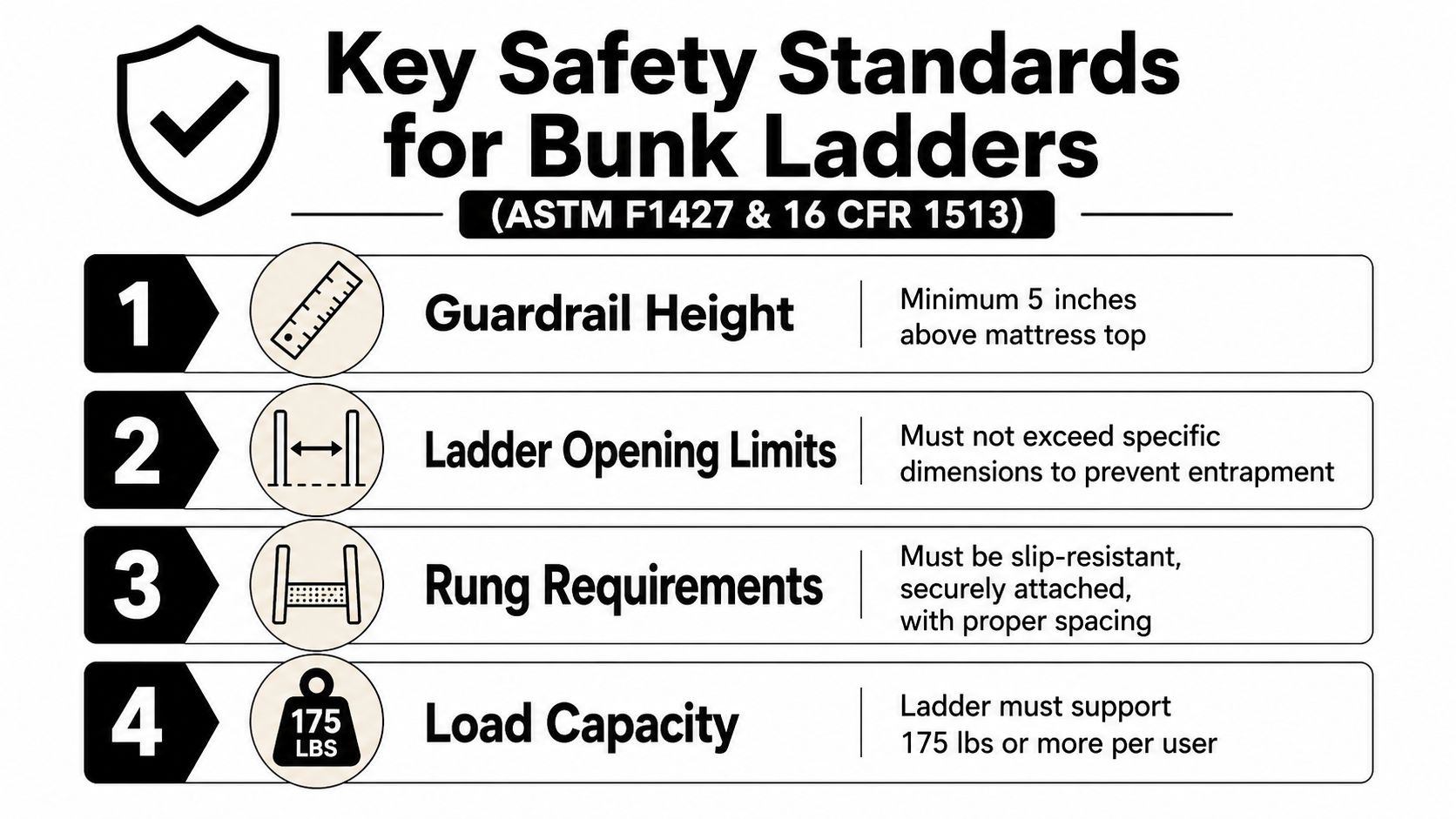
The rules behind a bunk bed with ladder are more specific than many buyers realize. In the U.S., the governing framework is ASTM F1427 and the federal bunk-bed rules in 16 CFR Part 1513, with related business guidance for adult bunk beds in 16 CFR Part 1213. Those standards focus on the hazards ladders create when openings, guardrails, and access geometry don't work together. The CPSC's bunk-bed business guidance spells out the core safety logic.
The numbers that matter in a custom build
For practical design, the upper bunk's guardrails must extend at least 5 inches above the mattress surface, and gaps in the guardrail and frame are generally limited to 3.5 inches. The ladder-side gap in the guardrail system may be no wider than 15 inches, and ladder rungs must be spaced no more than 12 inches apart center-to-center, according to the summary of ASTM F1427 and 16 CFR Part 1513 in this bunk-bed safety guide.
Those rules matter because the ladder can create the opening that breaks the guardrail system if it's not designed in tandem with the rail. A custom frame that looks sturdy can still fail the logic of the standard if the ladder opening becomes too generous or if the rung spacing doesn't match the climb path.
What to ask before approving a ladder
Ask for the ladder opening, rail height, and rung spacing together, not separately. That's where a lot of bad designs hide.
You should also ask how the ladder is attached and whether the rungs are intended for regular adult use. The built-in geometry has to support safe climbing, especially in a rental where guests may be tired or unfamiliar with the bed. If you want a quick checklist of the bigger safety conversation, this bunk-bed safety overview is the kind of reference that helps buyers ask better questions.
Removable Versus Fixed Ladders in Real Rental Use
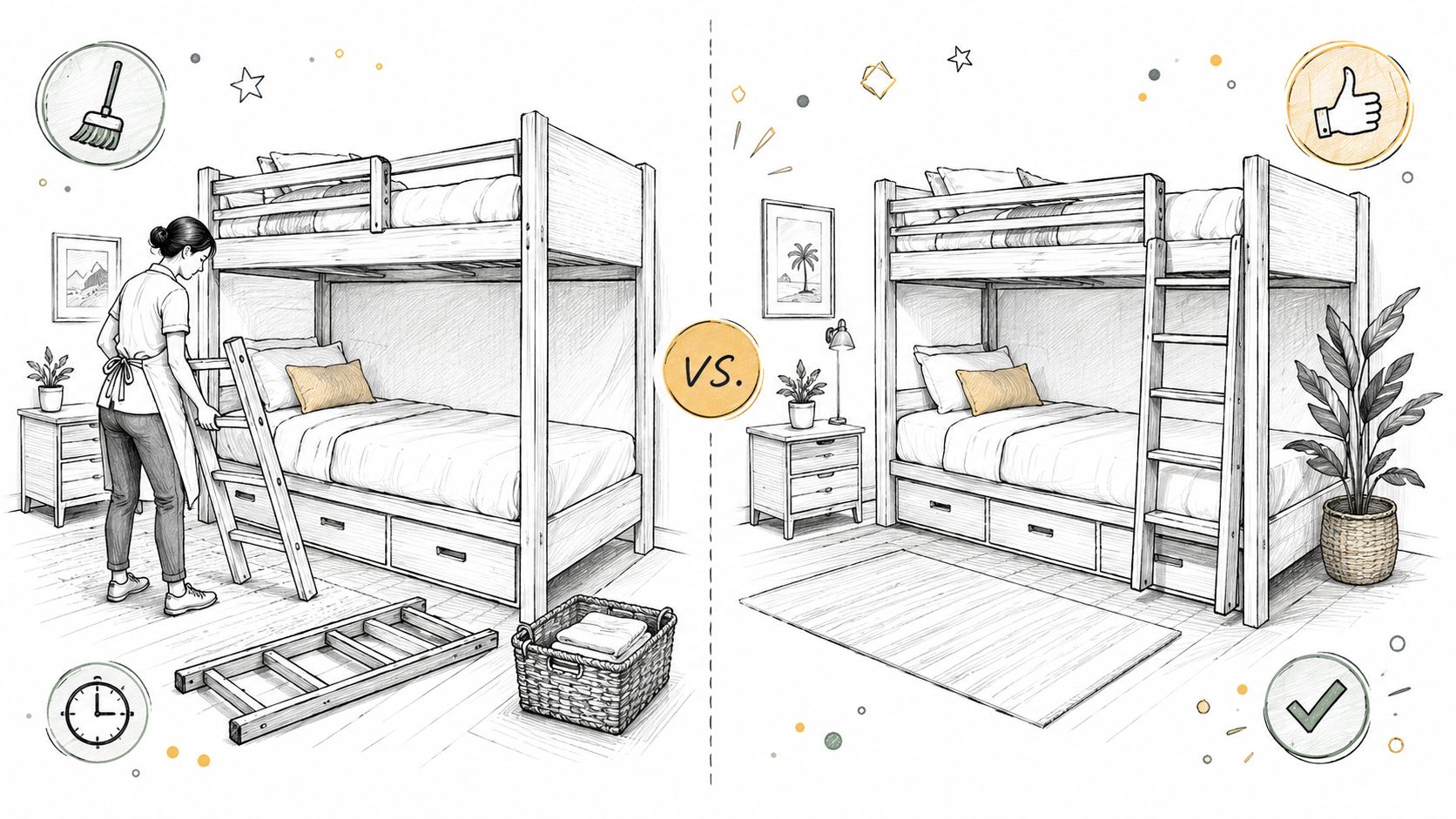
A removable ladder sounds convenient until a guest tries to use it in the dark or a housekeeper has to put it back in place correctly. A fixed ladder usually behaves better over time because the access path stays consistent and the frame can be engineered around a permanent load path. For rental operations, that consistency often matters more than the idea of flexibility.
Fixed ladders tend to suit turnover and adult use
Modern emphasis on fixed ladders, anti-slip steps, and rigid attachment reflects decades of injury surveillance rather than a style trend. The CPSC estimated that in 1989 about 34,000 bunk-bed-related injuries were treated in U.S. hospital emergency rooms, with roughly three-fourths of injured individuals under age 15, and 83 deaths of children younger than 15 were reported from 1973 through November 1990, according to the historical material in the CPSC bunk-bed standard PDF. That history is why fixed, stable access keeps showing up in safer designs.
For adult bunk beds, fixed ladders also reduce confusion during checkout, linen changes, and repeat stays. Guests don't have to guess where the ladder should sit, and the frame doesn't rely on an accessory that can get misplaced or loosely reinstalled. In properties with higher turnover, that's a real durability advantage.
Removable ladders still have a place
A removable ladder can make sense in some family rooms or lower-intensity setups where the bed needs occasional reconfiguration. It can also help in rooms that double as play space or need a temporary open floor area. The risk is operational, because loose-fit accessories are easier to forget, shift, or damage.
The right question isn't whether removable is “bad.” It's whether your guests, cleaning routine, and room layout can support the extra handling without introducing slop into the system. That's especially true in bunk beds for Airbnb and other short-term rental uses where the room must reset cleanly every time.
When a Ladder Is the Wrong Access Method
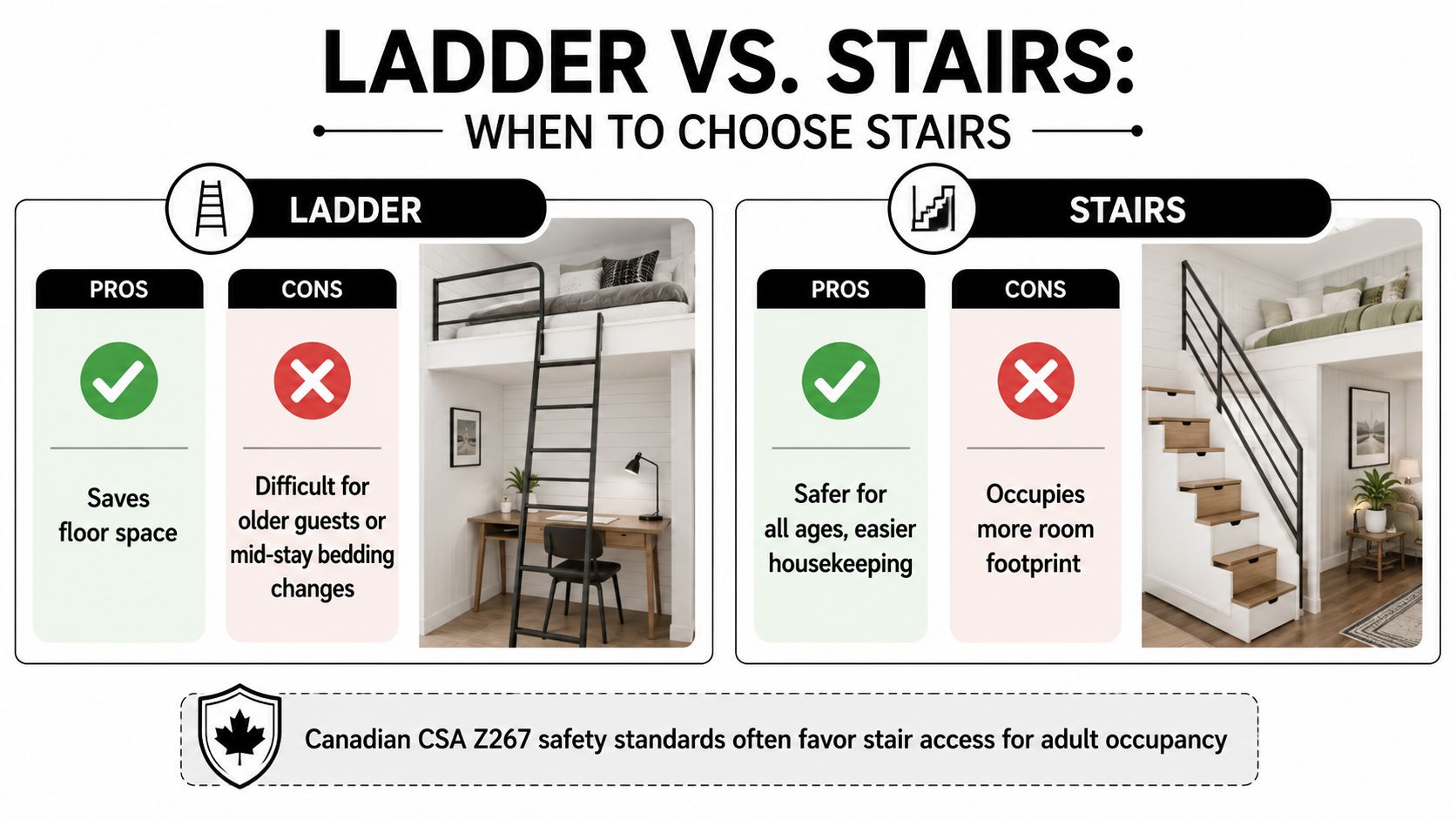
Some rooms are ladder rooms. Others are stair rooms pretending to be ladder rooms. The difference shows up when the property is designed for adult guests, grandparents, or high-turnover stays where people are carrying bags, waking up in low light, or using the space without prior familiarity.
Canadian surveillance recorded 6,002 bunk-bed injuries over 20 years, with almost one-fifth involving the ladder, and most injuries occurring at home, according to Public Health Canada's CHIRPP summary. That's a useful reminder that the access path is a routine-use issue, not just a child-safety issue.
Stairs win when comfort and operations matter more than footprint
Stairs usually make more sense when the room has enough space to absorb them and the bed will see frequent adult use. They also make housekeeping easier, because staff can reach the upper bunk with less awkward climbing. In a high-occupancy rental, that can matter as much as sleeping capacity.
If you're deciding between a ladder and stairs, the stair-based bunk-bed options are worth comparing against your floor plan before you commit. The key is not to default to ladder access just because it looks cleaner in a render.
A simple rule helps:
Choose a ladder when the room is tight, guest traffic is light, and preserving floor space is the top priority.
Choose stairs or hybrid access when the room serves adults, older guests, or frequent turnover and can handle the footprint.
Avoid a ladder when low light, mobility limits, or awkward access would make nightly climbing feel like work.
For some bunk room ideas, the right answer is not the thinnest access path. It's the one that fits the people who will use the room.
Planning Your Ladder Around Room Dimensions and Guests
Start with the ceiling before you start with the style. Multiple bunk-bed sizing guides point to 30 to 36 inches of clearance between the top mattress and the ceiling, with 8 feet often cited as the practical minimum ceiling height for standard layouts, while under 7 feet is generally considered unsafe or impractical, according to bunk-bed sizing guidance. If the room misses those benchmarks, the ladder decision may be secondary to the layout decision.
Then identify the actual guest profile. A room used by children on occasional holidays can tolerate a different access style than a bunk room built for adults in a ski house, beach condo, or family retreat. That's where custom bunk beds outperform mass-produced frames, because the access path, frame depth, and room flow can be aligned to the actual user.
A practical checklist for the buyer's side looks like this:
Measure the ceiling and mattress stack before looking at ladder style.
Map the door, window, and closet swings so the ladder doesn't block daily movement.
Decide who climbs first in real use, children, adults, or mixed-age guests.
Choose the mounting style that matches housekeeping needs and turnover speed.
Match the access method to the room's job, not just its appearance.
If you're building bunk beds for ski homes, bunk beds for beach houses, or a custom rental room in Park City, Heber, Midway, or elsewhere in Utah, the ladder should fit the people and the layout first. Once that's clear, the finish, rail style, and built-in look become much easier to choose.
For owners who want a room that sleeps more guests without creating daily friction, the next step is a layout conversation, not a catalog guess. Request a quote, compare ladder and stair configurations, and choose the access path that matches how the room will be used.
Park City Bunk Beds with Nationwide Delivery designs custom bunk rooms for real rental use, including ladder-equipped, stair-access, and built-in-look configurations that fit room dimensions and guest needs. If you're planning a bunk room for a vacation home, Airbnb, cabin, or beach property, visit Park City Bunk Beds with Nationwide Delivery to review options and request a quote for your space.
Comments